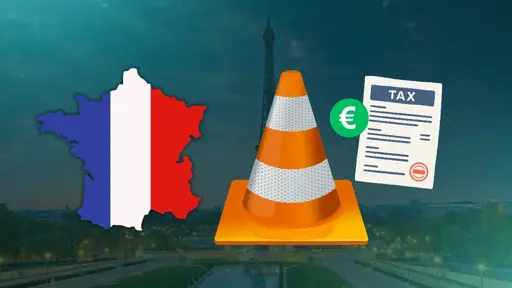
At least that’s what VLC thinks when protesting the new French law.
France’s National Assembly has voted in favour of a new “internet tax” that would charge companies for every gigabyte of data they send to users in France.
The idea is to make Netflix, Google, Meta and the rest of Big Tech pay more.
That sounds like a dream come true for many of us who prefer taking ownership of data in our own hands but unfortunately things are not that simple.
The way this law is written, it doesn’t stop at Big Tech. Even VLC, a free and open source media player maintained by a non-profit, could end up paying this new tax. What the new French internet tax says New French Internet Tax law
The measure is amendment I-1358 to France’s 2027 finance bill, tabled by Laurent Lhardit. It creates a tax on “producers of digital data” at €0.055 (5.5 euro cents) for every gigabyte delivered to subscribers of French internet providers.
Internet providers would measure how much data each sender pushes to their customers, with the collection supervised by telecom regulator Arcep and the tax administration DGFiP. Only the volume is counted, not the content or where it goes.
The amount is capped at 15% of the company’s revenue in France or 2% of its total revenue, as per the amendment. Note that it’s 15% of French revenue, not of total network traffic. And the text joins the two caps with an “or” without saying which one applies when they differ. How much money are we talking about?
The amendment cites an Arcep estimate of 200 billion GB a year flowing to French internet subscribers. It expects the tax to bring in €10 billion a year. It also names Google, Meta (Facebook, Instagram), Amazon, Netflix and Akamai (cloud server provider) as the senders of about half of that traffic.
You’d think the money goes to the telecom operators who build and maintain the networks. That’s the “fair share” argument European telcos have pushed for years.
But that’s not the case. The revenue goes straight into the state budget, and the amendment’s own justification talks about tax fairness between local businesses and digital multinationals, plus the ecological benefit of compressing data.
Why VLC is angry
A gigabyte of open source software counts the same as a gigabyte of Netflix. VideoLAN, the French non-profit behind VLC, posted on X that the tax would cost it over €1 million a year.
Lhardit replied that the cap would protect VideoLAN. He also said he didn’t see how the tax could be passed on to users of Facebook, Instagram or TikTok since those services are free.
VideoLAN didn’t take that well:
You have no idea what you are talking about. What you said about Facebook and Insta and other social networks are not targeted because they are free, means you don't understand the basics of economy. You don't understand the difference between Revenue and Profit.

VideoLAN (@videolan), October 30, 2026
The cap may limit what a low-revenue non-profit owes. But there is no explicit exemption for associations, free software or free content anywhere in the text. VideoLAN’s €1 million is the possible figure before the cap, and right now nobody can tell the exact figure for certain because of all the ambiguity.
VLC isn’t alone. OVHcloud founder Octave Klaba put his company’s gross exposure at around €70 million a year, and Free’s (Teleccom) Xavier Niel called the authors “ignares incompétents”, roughly “incompetent ignoramuses”. Those are French companies, by the way. Not exactly the US giants this internet tax bill was meant to tame. At the end, the consumer pays the bill
See, a “war on Big Tech” sounds great in a headline, and European governments are fond of laws that squeeze extra money out of American tech companies. But I don’t buy the idea that Netflix will pay them out of their pocket.
Netflix will do what it always does and raise subscription prices. And Facebook is “free” only because advertisers pay for it, which is exactly the revenue versus profit point VideoLAN was making.
So the government gets extra money, Big Tech protects its margins, and you end up paying. Meanwhile, non-profit projects like VLC, which never had a price to raise in the first place, are left wondering how big their bill will be.
Let’s just hope that this doesn’t take the form of law. Because this will set a precedence. I wouldn’t be surprised to see other European countries try their own version. No government will say no to extra tax revenue.
Like GDPR, this has all the ingredients of another mess. If a law is going to tax “internet companies”, it needs to say in black and white which ones. Right now, it doesn’t.
What do you think? A fair way to make Big Tech pay, or a blunt instrument that hits everyone else? Let me know in the comments.
I was broadly with them until the penultimate paragraph; the only “mess” GDPR has made has been one that was deliberately self-inflicted by petulant advertisers trying to make things difficult for users in an attempt to get it neutered, because it actually requires companies to treat your personal data with a basic level of care and respect.
I don’t understand. So, if VLC was downloaded from Tucows or GitHub…who pays? Surely not VLC, because as I read it, this taxes “producers of digital data” but the measurement mechanism is ISPs counting bytes by sender IP.
So if a French user downloads VLC from Tucows, Sourceforge, or Akamai’s CDN, the bytes come from Tucows/Akamai’s IP, not VideoLAN’s. Under a strict sender-IP reading, Tucows pays, not VideoLAN.
Wat?
If in some crazy world this actually goes ahead as written, one of two things happen
- Everyone on earth geoblocks French IPs
- Everyone dumps everything onto mirrors and washes their hands of it.
producers of digital data
They have an interesting take. What if they tax Sony for HBO streaming Spider-Man? What if it’s EMG for spotify tracks? almost impossible to track.
I think they’re more concerned about Github… but that follows.
What if I carry a pen drive of software across the border and give it to a frenchman. will that incur a fee.
High treason, I’m afraid. You’ll swing for that.
This is like fucking link taxes again. What this will do is make it harder for new companies to complete with established players
Yeah that makes sense. Populist policies with easy loop holes, nothing substantial. They’ll just pass the cost to customers in one way or another.
Maybe they should have policies to support and incentivize competition as well with it?
Anything to avoid making the actual problems pay their share of taxes. Now they can write the whole thing off as a failure and allow these other companies to continue paying the bare minimum.
Why not just charge a subscription tax? 🤔
They’ll do a 180 once the riots start.
Because VAT on internet service and subscription is not enough…
From what I understand, this still needs to pass another round of voting and presidential sanction and is likely to be rejected.
Still a stupid idea.
I god a self hosted blog, I’ll have to block french IP…
If you want shit you gotta pay taxes, such is life
Then implement a wealth tax on billionaires and bring back progressive income taxes. Macron pushed for a bunch of tax breaks in his first term and now France is predictably having issues with funding
WTF Why can’t they simply make companies pay proper taxes instead?
They currently dodge taxes by transferring all benefits to the country with the lowest tax rate within the EU: Ireland. It’s easy, you just have the Irish branch charging bullshit fees to other entities that match their revenues.
Besides that
https://www.cnbc.com/2019/07/11/france-passes-digital-tax-on-us-tech-firms-despite-trade-threat.html
But this previous tax was largely criticized for being ineffective against big tech also. Given it didn’t work that well, this one is the next attempt.
One day, one can hope, they’ll ask a tax expert instead of their guts… or asses…
They’ll just dodge 'em
Not like this bandwidth tax!
By how it’s formulated it sounds extremely airtight. Resuts
maywill differ in any application.
I see comments here calling these decisions dumb or stupid.
Plenty of cases everywhere of politicians passing laws claiming they have a certain purpose but will never work as intended.They already know this!
The so-called reason is a cover for their actions.
Like they use reasons of terrorism or child protection to impose more spying.
If you are giving them the excuse of stupidity it is you who is stupid.This is actually good for mesh networks.
This is actually good for mesh networks.
Ehh, kinda. Mesh and high-volume data aren’t great bedfellows. Where mesh shines isn’t what’s being taxed.
Exactly.
This only hurts the centralized internet, and forces people to get used to less bandwidth.
That would be nice, I have serious doubts that they’ll be ‘forced’, but here’s to hoping.
Wtf France! That’s a stinking pole of shit. Just tax wealth. Maybe at EU level.
Having such incompetent officials passing such stupid laws explains why French people riot so often.
That sounds like a dream come true for many of us who prefer taking ownership of data in our own hands but unfortunately things are not that simple.
How?? If it costs more to send data, Netflix will just send you lower quality video. You should want them to send you the same data or more data, but in a standard file type so it works with all your software and devices.
But hey, maybe companies will cut back on their node_modules folders now.