
You must log in or # to comment.
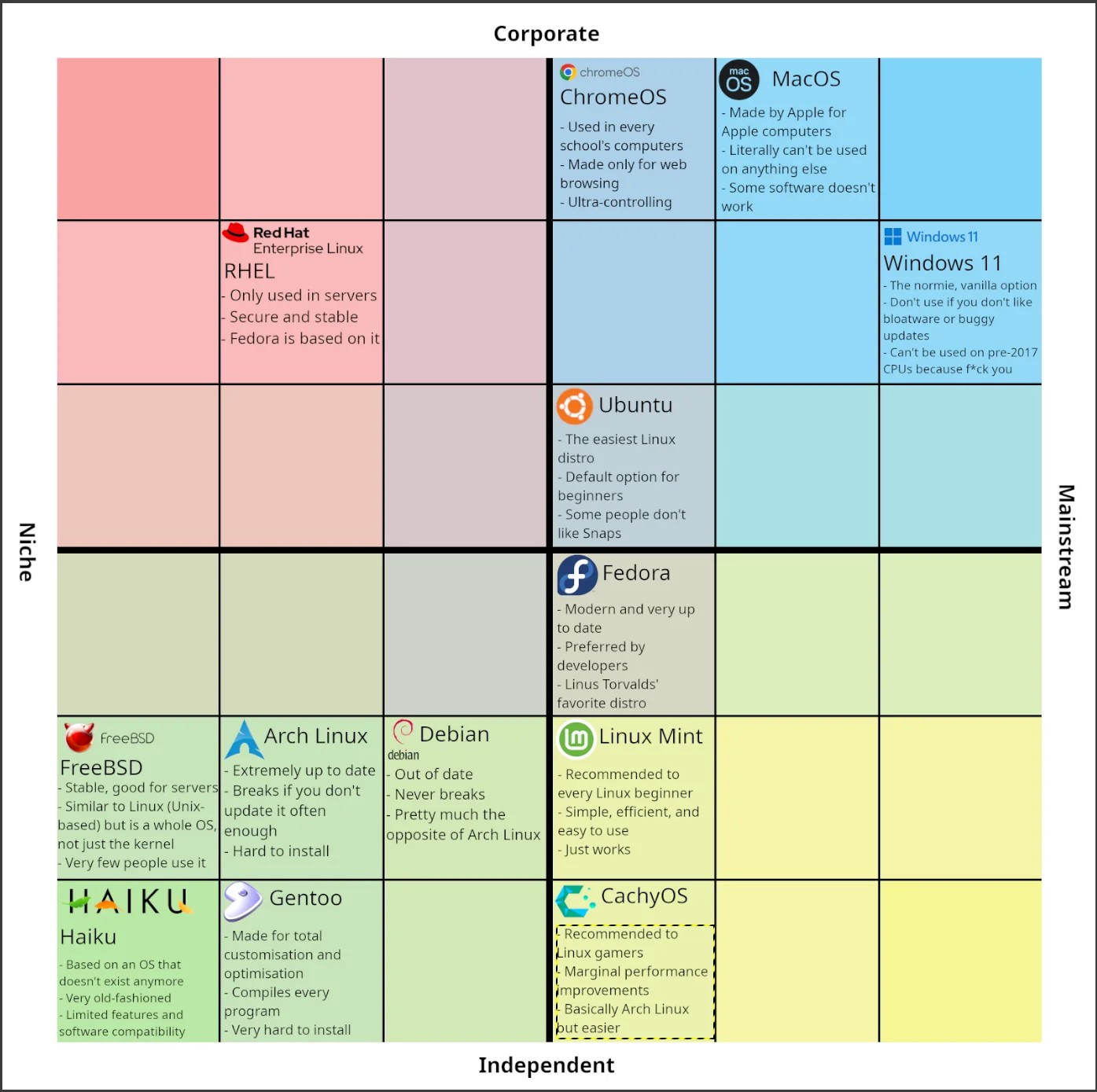
How is Debian More niche than cachy?
What would you change?
RedHat’s a corporation, and so move it to the right a couple squares, above Ubuntu. And move Windows up one.
And I’d add:
[PS, Sorry, I got carried away… ’ Originally intended to mention less than a couple dozen. LOL. Oops.]
- Slackware
- CRUX
- KISS (and/or) Carbs
- Venom
- BedrockLinux (What I use, since it was new.)
- Midnight BSD
- DragonFly BSD
- SuSe
- OpenSuse
- NixOs
- GuixSD
- PuppyLinux
- Void Linux
- PCLinuxOS
- TinyCoreLinux
- ALT Linux
- OpenBSD
- ReactOS
- Debian Hurd
- Guix Hurd
- Ironclad
- Kolibrios
- Slitaz
- Redox
- Illumos
- Oracle Solaris
- Open Solaris
- BeOs
- Plan9
- 9Front
- LFS
- Side GNU/Linux
- NetBSD
- OpenBSD
- Milis Linux
- Pisi Linux
- RED OS
- Vine Linux
- RISC OS
- Exherbo Linux
- BusyBox+Linux
- BusyBox+Linux+Suckless
- Crunchbang Linux
- ShredOS
- REDOX OS
- Menuet OS
- OpenIndiana
- UNIX
- IRIX
- Nekoware
- Android
- GrapheneOS
- Illumos
- Tribblix
- OmniOS
- Alpine Linux
- GhostBSD
- NomadBSD
- Witch (my own, abandoned/dormant since 2016
- MikeOS
- Pluto (a kernel written in zig)
- Amiga
- AROS
- MS DOS
- Free DOS
- Altair DOS
- RemixOS
- Sailfish OS
- Sinclair BASIC
- Xerox
- SkyOS
- DNIX
- MINIX
- Darwin
- TrueOS
- SerenityOS
- Plurix
- Inferno
- Eros
- Mach
- V
- Singularity
- HelenOS
- Harmony
- Oberon
- Sinclair QDOS
- AtheOS
- BareMetalOS
- HOS
- DreamberdOS
- GNU Emacs ;)
- TempleOS
Though I’m not sure where they’d all go. And many of these would have to double up in lib-left. And/or split up the chart into more squares.
And I’d cross-post to a political compass lemmy community. ;)
linux mint, but Debian edition, i feel is left of the centre split, but only a bit.
Yeah I don’t get what corporate means here. Debian was basically the corporate standard for a long while. Ubuntu was personal use
Ubuntu was devised pretty much as Linux for workstations, with Canonical selling support. Personal use was more of a side effect.
Debian is also the opposite of corporate since it’s a community project where the community aspect is central with democratic voting and no corporate control.
So then why would Microsoft be lower than Chrome or Apple with corporate? I wouldn’t say Windows has more democratic voting and less corporate control than them
Also with 70% of computers running windows, the chart would be scaled terribly along the x axis. You would have to shift every Linux to box 1 with chrome, and put Mac in box 2/6
Windows (either 11 or 10) needs to be in the top right corner. MacOS should be one notch down vertically. Ubuntu and mint both move one notch right. Cachy moves one notch left. Gentoo moves two to the right.
I am not sure I understand your logic behind Cachy and Gentoo. Cachy is actually quite mainstream now and Gentoo is… less so.
I think there’s just not enough tiles here. FreeBSD is definitely more mainstream than Haiku, but less so than Gentoo, let alone Arch.
Arch isn’t hard to install (anymore). It takes 5 minutes with archinstall.
btw
Helps if you know that command/setup thing/whatever you wanna call it. Otherwise, for someone who doesn’t know about it, the process can be pretty painful. Even with the wiki’s install instructions I have not been able to install arch the few times I tried in a VM over the past few months.
where mah nixos
How about above arch Linux? Or at least in that column. Maybe further down
I’d put Haiku on the extreme top left corner (or in one of the two rows below that first column) since it’s based on BeOS - it’s a corporate OS wether it exits or not and it intends to replicate said corporate OS. In its place I’d put either TempleOS or Plan9.
TempleOS. Oh jeez it’s been awhile since I’ve heard that.
If you ask me, the top left corner belongs to IBM i.
How is Windows less corporate than MacOS or ChromeOS?
Based on the image, it seems like the argument is that Windows can be installed on a larger variety of devices than the other two
Yeah, but Microsoft shouldn’t get credit for that. Windows only works with everything, because everything got built around it.
Drivers are needed for every little bit of hardware, Intel very well might not have become the dominant architecture if Microsoft hadn’t picked it in the 80s.
but then it should be “restricted” at top, and not “corporate”?
PikaOS right under debian
Add another square at the bottom left of the grid that breaks out of the grid on both directions and contains OpenBSD.
I came here to complain about the lack of OpenBSD
And slackware
Put windows 10 just below windows 11
CachyOS a bit to the left. It is not at all mainstream in my bubble.
NixOS on the niche and corporate quadrant.
Where do we put QubesOS
Some people don’t like snaps
“Some people like snaps” would have been closer to the truth, but it would still be an exaggeration of their numbers.
You know what? I know they’re far from the ideal solution, but I have installed a few things with snaps … and it was fine. It worked seamlessly and painlessly (in some instances).
Generally, I’d prefer other ways to install, but snaps aren’t the end of the world.
(This concludes my hot take of the day.)
snaps aren’t the end of the world
System engineers all collectively shuddered at that thought. Then OS security nerds.
This is the “I tried heroin and it was good” story but for OSes
pretty soon we’ll need snaps in our snaps to make it easier for developers to create snaps with snap dependencies

Snap maintainer here - this makes no sense whatsoever.
And if I tried heroin and it was bad was also even more common.
It’s not a question whether they work or not. It’s whether you’re okay with an app distribution system that forces us to be dependent on one corporation. Snap’s backend effectively makes Ubuntu almost as bad as Android.
And seeing as there is no shortage of better options, why not choose those?
I bet Mark Shuttleworth likes Snaps.
“A person likes snaps.”
There, all covered and more accurate than the original.
His mom probably likes them too.
His dad probably says “WTF is this Snap bullshit son? We didn’t raise you like that.”
Then his mom replies, “it’s just a phase, he needs our support, I’m sure you can make snaps happen, sweetie.”
Arch Linux breaks if you don’t update it often enough
pacman -S archlinux-keyringIt’s really that easy