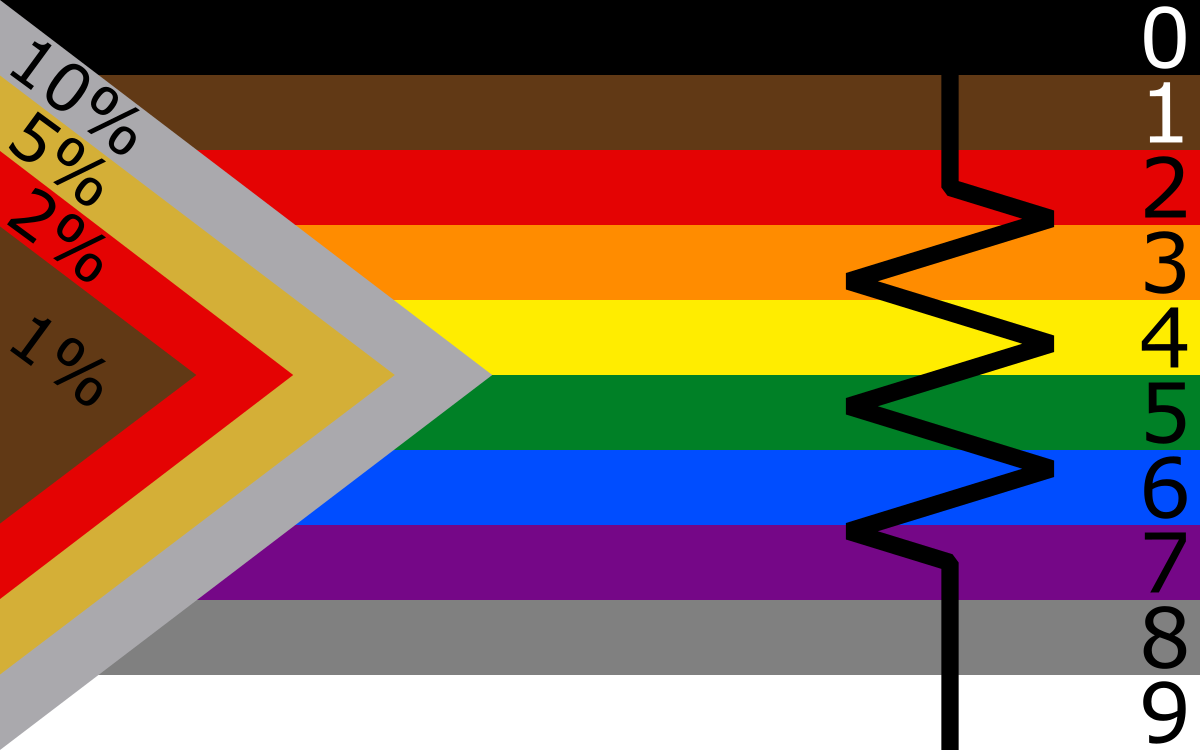
Something something queer joy is resistance
there is way too much brown in it

still uses the ANSI symbol for the resistor and not the international symbol as described in IEC 60617
what’s the difference? does the curve start the other way?
What does this all mean? I assume it os about the strength of resistora but I don’t get the numbers/formula
Smaller axial lead resistors mark their resistance values using colored bands. Three or four bands grouped together, towards one end of the device, mark the nominal resistance. If there are three bands, the first two represent the tens and ones (A, B). If there are four bands, the first three represent the hundreds, tens, and ones (A, B, C). The final band is the multiplier or magnitude (M).
For example, the three-band code of yellow-purple-red represents a nominal resistance of 4.7 kiloohms. The first yellow band is 4 × 10, the second purple band is 7, and the third red band is a multiplier of 100:
(4 * 10 + 7) * 100 == 47 * 100 == 4700.An optional band, painted on the other end of the device, marks the accuracy or tolerance in percents. If there is no such band, assume a tolerance of 20%.
Pride resistance