

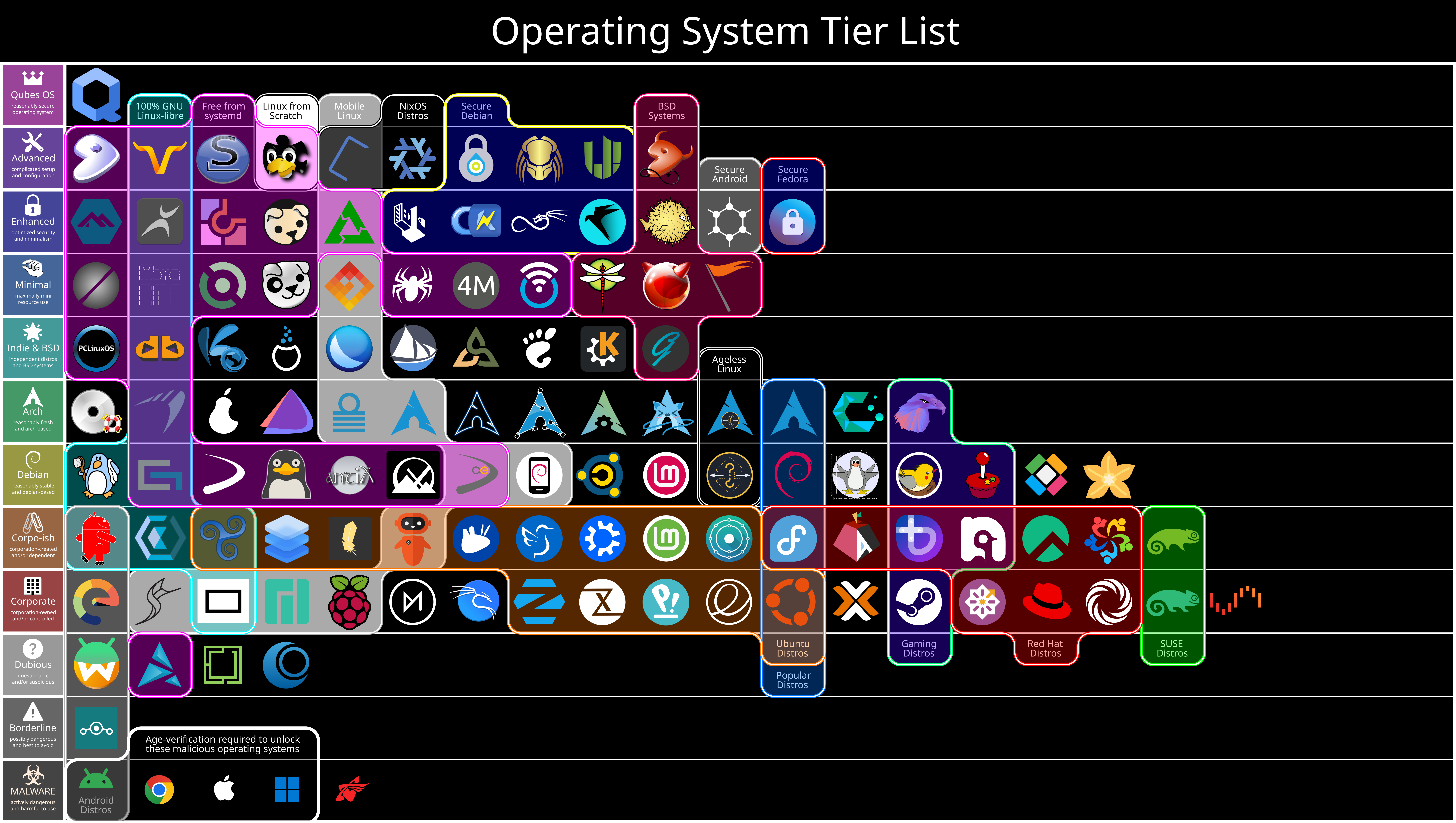
So I saw political compass memes a while ago and started making one, but then I started taking it too seriously and eventually turned it into a tier list. Idk if it makes sense to share it here, but idk where else to share such a thing. I also made a browser tier list, but idk where to share that either.
This whole thing is a png export of a pure svg image. For some of the logos, I had to make them either from scratch or by using gimp and inkscape to convert a png into an svg (imperfect but good enough).
Hopefully this is all formatted properly.
OS Tier List
S-Tier (reasonably secure operating system):
- Qubes OS
Advanced (complicated setup and configuration):
- Gentoo Linux
- Guix System
- Slackware Linux
- Linux From Scratch (LFS)
- Mobile NixOS
- NixOS
- Whonix
- Predator-OS
- Linux Kodachi
- Gentoo FreeBSD
Enhanced (optimized security and minimalism):
- Alpine Linux
- Hyperbola GNU/Linux-libre
- Chimera Linux
- EasyOS
- postmarketOS
- Tails
- Kicksecure
- NetHydra
- ParrotOS
- OpenBSD
- GrapheneOS
- Secureblue
Minimal (maximally mini resource use):
- Tiny Core Linux
- LibreCMC
- Void Linux
- Puppy Linux
- AsteroidOS
- Slitaz
- 4MLinux
- OpenWrt
- DragonFly BSD
- FreeBSD
- NetBSD
Indie & BSD (independent distros and BSD systems):
- PCLinuxOS
- Dynebolic
- KaOS
- Mageia
- LuneOS
- Solus
- AerynOS
- GNOME OS
- KDE Linux
- GhostBSD
Arch (reasonably fresh and arch-based):
- SystemRescue
- Parabola GNU/Linux-libre
- pearOS
- EndeavourOS
- Nemo Mobile
- Arch Linux Arm
- BlackArch Linux
- Archhurd
- Archcraft
- Nyarch
- Ageless Arch
- Arch Linux
- CachyOS
- Garuda Linux
Debian (reasonably stable and debian-based):
- Flora Linux-libre
- Genuen
- Devuan GNU+Linux
- Loc-OS
- antiX
- MX Linux
- Maemo Leste
- Mobian
- Emmabuntüs
- Linux Mint Debian Edition (LMDE)
- Ageless Linux
- Debian
- KNOPPIX
- PikaOS Linux
- RetroPie
- LibreElec
- Vanilla OS
Corpo-ish (corporation-created and/or dependent):
- Replicant
- Uruk GNU/Linux-libre
- Trisquel GNU/Linux
- AnduinOS
- Linux Lite
- UBports
- Xubuntu
- Lubuntu
- Kubuntu
- Linux Mint
- KDE neon
- Fedora
- Asahi Linux
- Bazzite
- Nobara Linux
- Rocky Linux
- AlmaLinux
- openSUSE
Corporate (corporation-owned and/or controlled):
- /e/OS
- Sailfish OS
- PureOS
- Manjaro Linux
- Raspberry Pi OS
- OSMC
- Kali Linux
- Zorin OS
- Tuxedo OS
- Pop!_OS
- elementary OS
- Ubuntu
- Proxmox
- SteamOS
- CentOS Stream
- Red Hat Enterprise Linux (RHEL)
- CloudLinux OS
- SUSE Linux Enterprise
- Unraid
Dubious (questionable and/or suspicious):
- Waydroid
- Artix Linux
- Omarchy
- OpenMandriva
Borderline (possibly dangerous and best to avoid):
- LineageOS
MALWARE (actively dangerous and harmful to use):
- android
- chromeOS
- Apple Operating Systems (macOS, iOS, etc.)
- Windows
- Red Star OS
In theory, any Linux OS can be more secure if you know what you’re doing. Just write all the software yourself and don’t write any bugs!
I more meant stripped down to just what you need for a given use case down to the library level. You only need to write software for LFS…
Well you still need to run stuff on the computer. Like a browser. And if you want that to be secure as Qubes OS, you’d wrap the browser in a VM. To defend against usb attacks and networking attacks, you’d wrap those interfaces in a VM too, like Qubes does. Then have a way of routing the networking between the VMs. Etc etc. So it’s not just stripping things down. You have to build things up too, if you want to emulate Qubes.
Hardware segregation › virtual. Im not really thinking general purpose either.
Not sure what you mean by hardware segregation. If you mean, having multiple PCs, then that can actually be less secure. You now have to secure multiple devices against physical attacks, instead of just one. And you have to figure out how to transfer files securely between them.
What’s the setup you’re thinking about?
If you want anonymity not just security you can do whonix on hardware or I2P on a seprate host with a minimal headless install. I’m thinking more along the lines of a machine that only does a single job like a chat app client, a server, a word processor, CAD, etc… IRC, simplex and others don’t even need X or wayland.
Qubes has Whonix templates to make it easy to dispose and recreate your Whonix VMs. And as the other reply said, handling networking is not trivial, tons of opportunity for user error if you try to do it yourself. If you want to give it a shot for fun, nothing wrong with that. Just don’t expect it to be as secure as Qubes, unless you are actually a security expert