Concrete has a a very high carbon footprint. The manufacturing of cement liberates a shitload of CO2 that had previously been in the ground as minerals. Different reaction from burning fossil fuels but indistinguishable as far as the atmosphere is concerned. Not to mention cement plant furnaces are usually fossil fuel powered.
Since the blocks are not (as) structural, less cement and more gravel/old concrete fragments can be used which would mitigate this to some extent, but I’d still imagine this is pretty similar to electric cars where it takes a significant portion of its service life to even reach net zero from the carbon released from building the thing.
Concrete is quite possibly the worst material ecologically speaking for this application. Presumably it was chosen for its physical properties, but still. I do wonder if just using straight stone quarried directly into the final block shapes could mitigate some of this, since concrete is basically just stone whose shape and composition we can control, and either way the same mass of material needs to be mined out of the ground so I imagine they’d break even on mining ecological footprint. In fact, if you just need something heavy to store gravitational potential energy, and water is not viable for whatever reason, why not use crushed cars or something?
Cement is also a by-product in the manufacture of steel in blast fumaces. There where steel is made, there is also produced cement.

The reason why you generally don’t use quarried stone when you can use concrete is that concrete has very consistent properties that can be manipulated with production and building techniques whereas stone is unpredictable in lots of conditions.
That can be overcome but suddenly you’re dealing with the builder equivalent of woman_surrounded_by_math.gif and the next person who comes by to check the work has to be that too.
When you do it with concrete you can very easily make sure you’ve got a predictable material and when someone wants to check your work there’s a million simple pass fail ways to do so.
If I were building a gravity battery that was designed to be around anything I would run screaming from block.
Everybody’s gangster against concrete till u gotta build something that might fall on a persons head.
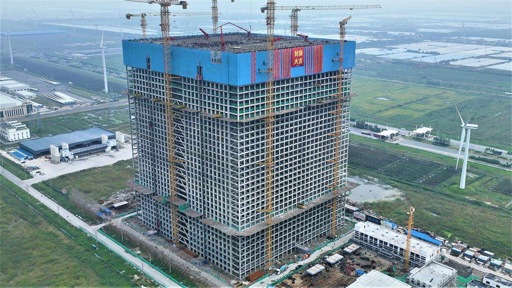
Surplus wind power hoists 35-ton blocks cast from recycled concrete and industrial aggregate toward the top.
Using recycled concrete seems be a solid mitigation for the environmental concern. The world’s got no shortage of scrap concrete.
I mean, unless they’re directly cutting up old buildings into the final block shape for this (which would be a nightmare to actually do), it doesn’t actually help that much. You can’t practically un-make concrete and turn it back into that slurry that comes out of the mixer truck, AFAIK all “recycled” concrete means is old concrete gets crushed into fragments and used in place of gravel. But the gravel is not the truly problemic part, you still need more cement to bind those fragments into your desired shape, which releases carbon and consumes water.
(Reposted from another reply in the same thread)
Didn’t the math not check out on this particular technology when it was proposed by western venture capitalists years ago?
looks like it was a skills issue
At least it’s an enclosed building this time and not a freestanding stack of blocks with wind sensitive construction cranes on top.
Sorta curious how this compares to pumped hydro with a giant water tower - or a deep pit and store the water at ground level.
I would expect it would be pretty similar, in each case you’re lifting a mass to create some potential energy and then draining it later. I can’t imagine the work involved in pumping up water is all that different in terms of efficiency from lifting concrete. The advantage with concrete is that you can do it in places where you don’t have huge amounts of water to spare though.
High friction is my guess.
I mean, it’s not like concrete is scraping on the walls going up and down, it’s on a pulley system which would be efficient in terms of doing energy transfer. The article mentions round-trip efficiency above 80 percent, so I’m not sure pumping water could be much more efficient than that.
https://dothemath.ucsd.edu/2011/11/pump-up-the-storage/
The main problem with gravitational storage is that it is incredibly weak compared to chemical, compressed air, or flywheel techniques (see the post on home energy storage options). For example, to get the amount of energy stored in a single AA battery, we would have to lift 100 kg (220 lb) 10 m (33 ft) to match it. To match the energy contained in a gallon of gasoline, we would have to lift 13 tons of water (3500 gallons) one kilometer high (3,280 feet). It is clear that the energy density of gravitational storage is severely disadvantaged.
It seems the problem is not necessarily one of conversion efficiency, but rather of scale. In order to store significant amounts of electrical energy using mechanical means, you need to move a lot of weight. Manufacturing the concrete blocks requires money and raw materials, and a pulley system robust enough to move them around wouldn’t be cheap either. The pumped storage hydroelectric systems which currently provide the vast majority of our grid energy storage partially circumvent this expense by taking advantage of natural bodies of water and advantageous topography.
That being said, it’s definitely a fascinating concept and one worth exploring. But there are well established difficulties that explain why this type of energy storage isn’t already widespread.
right, it only makes sense if you do it at large scale
it only makes sense if you do it at large scale
Or rather, it specifically might NOT make sense at scale. It might only make sense in middle scales, where there isn’t a topographic advantage to use, but the requirement is more than batteries can support.
What I meant is that you need to build a unit of a certain size before it becomes efficient enough to be practical.
What about friction within the pulley?
Again, they state over 80% efficiency in the article. So, that’s your answer.
Well, this 80% efficiency is what they are targeting not what the system will do. The test system Energy Vault build in a MUCH smaller form factor had a round-trip efficency of 75%
The EVx ™ system is projected to achieve an impressive round-trip efficiency exceeding 80%. Source
Only time will tell if they can reach 80% with a bigger system or at all. If they actually manage this it would be a decent alternative to Hydrodams in areas where these are just not possible since it would be a similar round-trip efficency.
Pumped storage systems have a round-trip efficiency of about 80%, which is competitive with battery storage. Source
In my opinion these systems are inferior to fly wheel energy storage (can reach up to 90% round trip efficency Source) but might still be an option depending on price.
Fly wheels are pretty cool too, it could be that this is just easier to build and maintain though. I imagine the primary considerations are around how cheap it is to produce and whether it holds enough energy to make it worthwhile.
Water is way, way cheaper, and concrete requires a massive amount of water.
Just saying.
Water also doesn’t get damaged through constantly moving it.
Thats a pretty fucking big on. Also, the technology to “turn a wheel” to create electricity… pretty fucking established.
And… god forbid, if the community you are in ends up needing water more than electricity, well, you’ve got a bunch stored and ready for other uses.
the article says it’s recycled though…
I mean, unless they’re directly cutting up old buildings into the final block shape for this (which would be a nightmare to actually do), it doesn’t actually help that much. You can’t practically un-make concrete and turn it back into that slurry that comes out of the mixer truck, AFAIK all “recycled” concrete means is old concrete gets crushed into fragments and used in place of gravel. But the gravel is not the truly problemic part, you still need more cement to bind those fragments into your desired shape, which releases carbon and consumes water.
But you do that once, and the thing lasts 35 years, somehow I can’t imagine environmental impact would be worse than mining and refining rare earths for regular batteries here.
I can’t imagine environmental impact would be worse than mining and refining rare earths for regular batteries here.
I mean it depends on the energy density. Where the batteries go. Can they be just “slapped into” existing infrastructure? Can they rare earths be used effectively indefinitely once mined, and on and one and on.
An inability to imagine isn’t a form of evidence.
Energy density has nothing to do with this. It’s the cost of how much pollution refining the rare earths and making batteries produces vs the amount of pollution associated with construction of a building with pulleys that move weights up and down.
I mean I would guess it’s for energy density not environmental savings of any kind.
I would guess it’s because it’s likely very low cost and easy to build, but there are obvious environmental savings that fall out of it naturally.
savings that fall out of it naturally.
sigh… Buh dim tish.
On the topic, I really doubt it’s about savings at this scale, which is very much proof of concept. I mean it could be but at this stage it’s more important to show it’s potential. And for some thing that’s gonna run for thousands of cycles…
My vibes say that pumping water is way less efficient than moving blacks with rope and pullies. Think about water turbulance and drag on pipes. I feel like that would be way less efficient than a motor thay directly pulls up a weight
that would be my intuition as well
deleted by creator
yeah it’s pretty clever and I love the low tech approach
deleted by creator
You could also fill the tower with water pipes and use that to store energy.
You could also store the water in an elevated lake, and then use pipes and generators to pump it from the low lake to the high lake.
Could slap some solar panels on them to double dip too
Soooooooo Timberborn was right all along?