

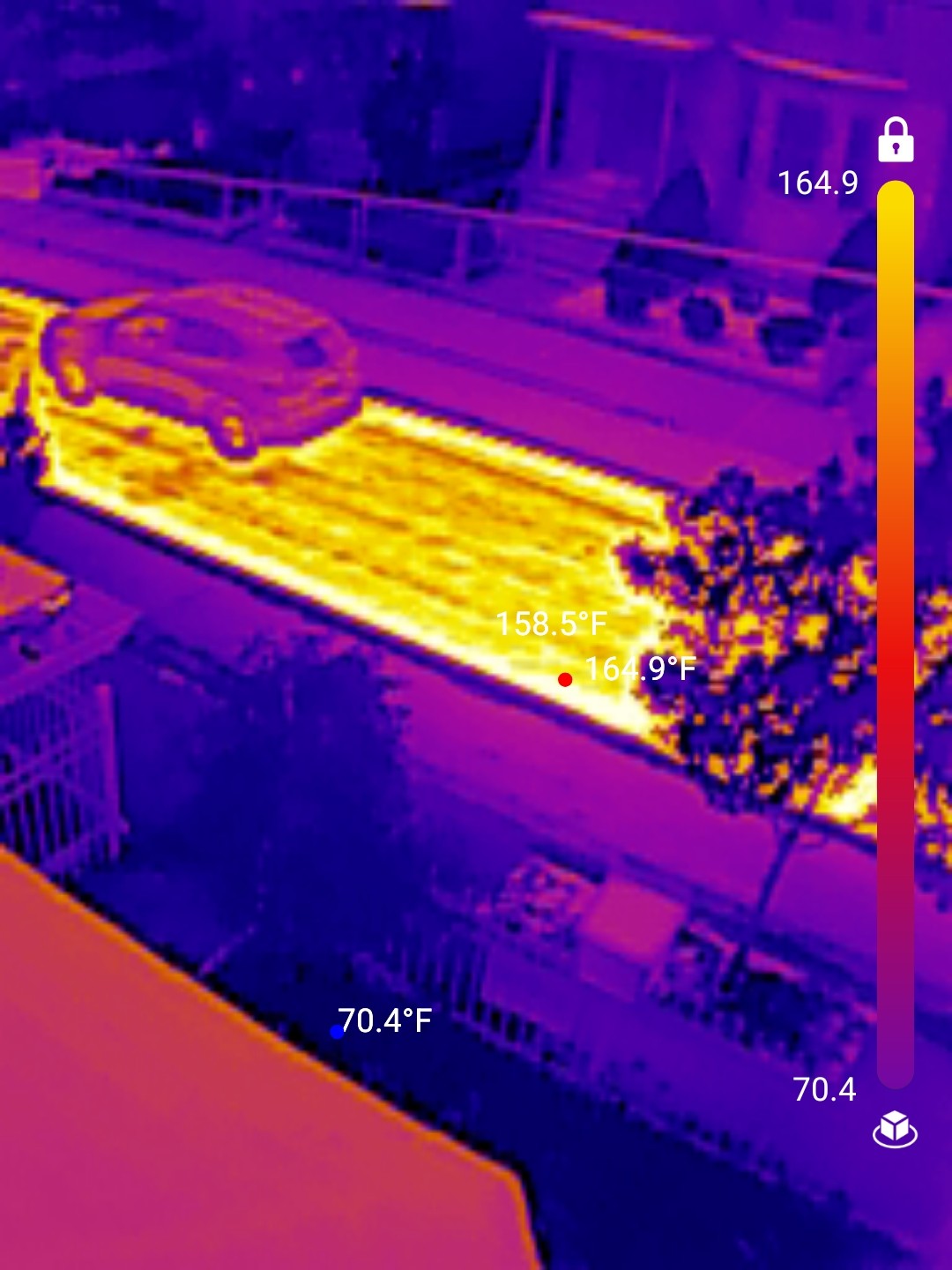
I could feel the heat coming off it when I stood next to the repaved section. They didn’t repave the parking area at the edge. Opened to traffic again, seems firm enough to drive on at 160⁰F.
I could feel the heat coming off it when I stood next to the repaved section. They didn’t repave the parking area at the edge. Opened to traffic again, seems firm enough to drive on at 160⁰F.
Even though this article says that tire rubber starts to break down and melt between 100⁰C to 150⁰C, depending on the rubber compound, I’d still prefer to protect my tires from such high temperatures…
https://thetirereviews.com/is-it-true-tires-can-melt-because-of-heat/
Edit: Those temperatures are also rather dangerous for electric vehicle batteries, which are located right under the vehicle in very close proximity to the road heat.
Unless you have a Nissan Leaf or an UpMiiGo your battery has some sort of active cooling.
I guess you don’t understand active cooling then. If the coolest air in front of you is ~160⁰F, well that’s the coolest your batteries are gonna get, at best. Which is way hotter than rated temperatures for lithium batteries…
I’m not sure if you’re being deliberately misleading. I’ll just assume you’ve never owned a somewhat new-ish ev. None of those with active cooling use the outside air, almost as follow this kind of layout:
The circled part is the important one. Hell, even the first Gen ioniq which had an air cooled battery drew in chilled air from near the rear passenger ducts.
If the car isn’t using outside air for cooling, where is the heat going?
The same way a fridge works
So, where does that heat go?
Last I checked, a fridge uses the outside air to cool the heat exchanger
Compressor heats up coolant, coolant exchanges heat with outside, cools down then evaporator cools it further, heat exchanges with cold loop then goes to be compressed again. It’s the same principle that freezers and ac use, with the phase changes of the coolant you force them to move thermal energy in the desired direction.
Last I checked, my fridge works even when the room is warmer than the fridge.
Yes, and it cools stuff to cooler than the outside air, right?
Based on the image they shared, the heat goes into the refrigerant, which then goes to a radiator to transfer into the outside air.
It doesn’t use outside air in the sense that the battery doesn’t transfer heat directly to the outside air. There’s the refrigerant between the two.
Right, that’s what I’m getting at. The heat indeed gets transfered to the outside air.
It makes more sense if you read the context. They’re responding to a comment that said this:
A response that says “it’s not X” can be interpreted as “it’s not doing the thing you said it’s doing”. In this case, over_clox is saying that heat transfers directly from the battery to the air.
Yuh, you ever tried to run an air cooler system, of any sort, with 160⁰F / 71⁰C as the input air temperature? That’s how you overstress underrated systems and shit fails anyways.
Where are you pulling these numbers from? I’m relatively sure you’re just making some up by now until you hit one where any concept that has been explained to you will not work.
Contrarianism should not be entertained.
Been there, experienced that, in my pocket no less.
https://safelith.com/temperature-limits-for-safe-lithium-ion-battery-usage/
Matter of fact, we got a phone battery on order to replace a spicy pillow. I should go check the mail now…
Could you share more details about the active cooling system for your particular phone?
Yes. Heat rises. And the device should never get that hot.
150C is over 300F
Yes, and EV batteries aren’t safe over 40⁰C
There’s no way that’s true
Of course it isn’t. My eTron targets 45°C temperature in the pack while fast charging.
Nobody asked about charging temperatures. We’re literally talking about road temperatures.
Guess what? 160⁰F ≈ 71.1⁰C, way beyond safe operating conditions…
Are you just throwing dices for numbers now? Above your were talking about 40°C.
Okay, ± 5⁰C, so what?
OP is talking about road temperatures over 70⁰C.
I’m sure that even within your varying expertise, you should be able to recognize the obvious danger to EVs here…
Road temperature is not air temperature, on a sunny day, go out, measure the road and compare it to the air above it.
It’s not, many EVs intentionally heat up to over 50°C during fast charging. They also have several layers of material between the bottom of the battery and the road along with airflow across the entire area, so radiant heat isn’t going to have a meaningful impact.
https://safelith.com/temperature-limits-for-safe-lithium-ion-battery-usage/
0⁰C to 45⁰C, and you act like vehicles don’t get stuck on the road in traffic?
Road temperatures of ~160⁰F are around 71+⁰C.
Please do your math before declaring temps are safe for lithium batteries, 160⁰F / 71.1⁰C most certainly is NOT safe for them.
Eh?
???
Above 45⁰ Celsius, there’s a high risk of lithium ion thermal runaway (aka EV explosion).
Also, temperatures as little as anything above 37⁰ Celsius are known to cause infertility in men.
Did you even read the link you sent us?
Jesse. What the fuck are you talking about?