

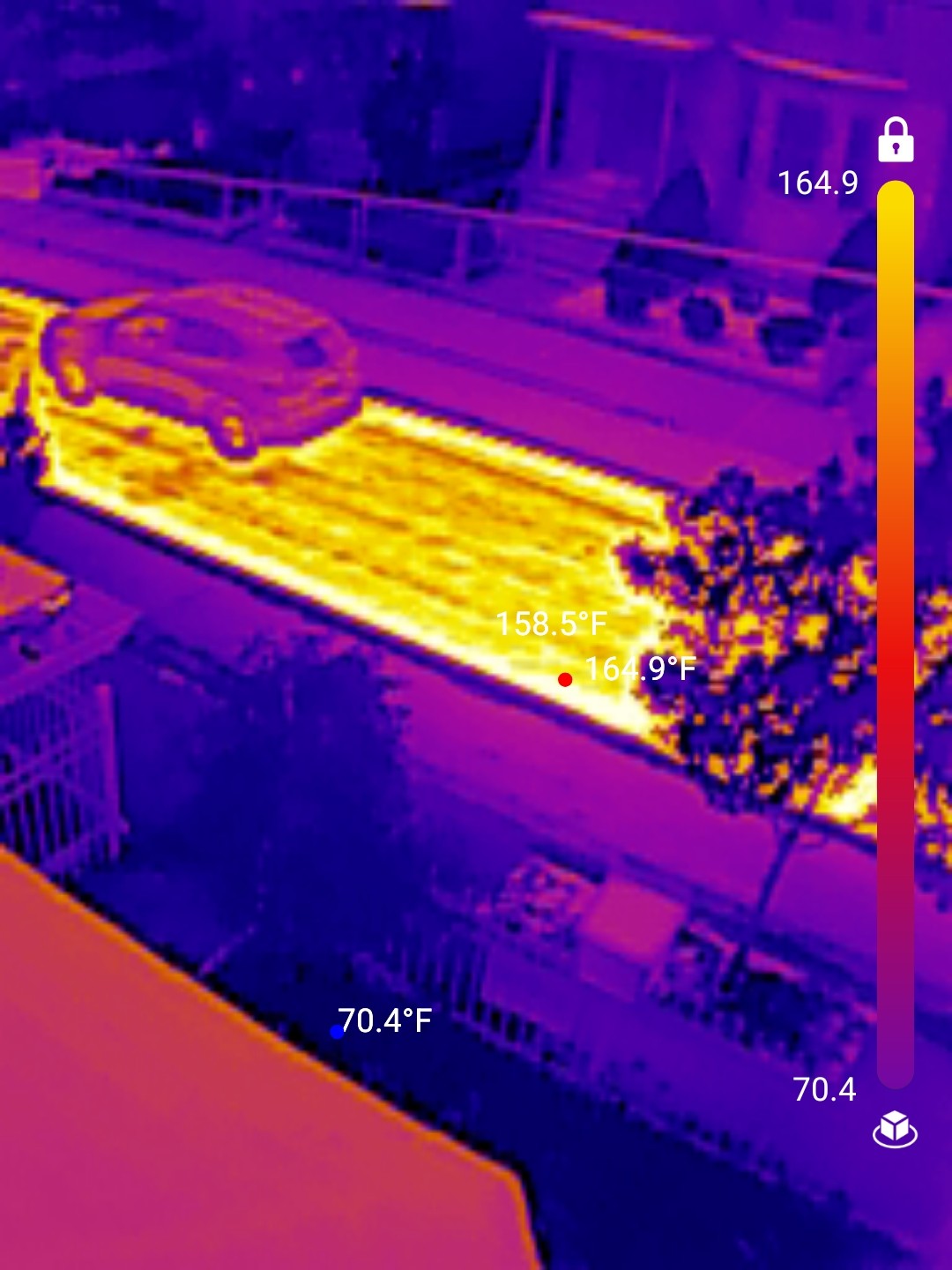
I could feel the heat coming off it when I stood next to the repaved section. They didn’t repave the parking area at the edge. Opened to traffic again, seems firm enough to drive on at 160⁰F.
I could feel the heat coming off it when I stood next to the repaved section. They didn’t repave the parking area at the edge. Opened to traffic again, seems firm enough to drive on at 160⁰F.
You’re ignoring that the pavement being that temperature doesn’t mean that the battery will be that temperature. There’s a layer of air between the road and the car, as well as other physical barriers. The battery is also actively cooled.
Active cooling means practically nothing at those temperatures, any cooling system is just a heat transfer device, that also generates heat itself. It just moves the heat elsewhere.
So sure, it’ll help cool the battery, but what power it takes for the battery to cool itself comes from the battery itself, thereby heating it up even more as it fights to cool itself.
Depends on the type of cooling, but even the less efficient cooling systems will be using a tiny fraction of the battery output, like less than 1% for most. Passively cooled batteries are going to have problems for sure but even then I’m not convinced there would be enough heat transfer for long enough from a 70 degree road surface to actually be a serious problem. The road itself would be cooling and unless you’re just sitting over it for a long time it’s not likely to become a real problem. A somewhat pessimistic (for volume, not for actual capacity) estimate would be 300kg of battery mass for 100kwh. Assuming middle range lithium ion thermal capacity that’s about 300kj per degree k. So for maths convenience let’s assume the car is 10m^2 on the underside and that’s all in contact with the battery, going by the previous estimates (again, worst case for battery overhead purposes) and assuming the air is moving and already preheated to 70 degrees c it would take around 5 minutes to heat the whole battery to 70. Thanks for the maths problem though, was interesting to look into this stuff, I’ve made some big assumptions but it’s looking very unlikely you’re realistically going to have big issues with overheating unless you spend an inordinate time with an EV sitting over hot asphalt, I didn’t consider radiative heat transfer but I wouldn’t think that would make a huge difference given the albedo of asphalt also the ambient air would probably help cool more than I considered. It would be neat if someone with more knowledge on the equations has input though.
There exists stop signs, red lights, traffic, and trains…
Never assume you won’t be parked for more than 5 minutes…
Ofc but I made some big assumptions with regards to ambient temperature, battery mass and lack of functional cooling. 5 minutes is absolute worst case with 70 degree ambient air.
You don’t know what the fuck you’re talking about.
What temperatures? The 71°C of the pavement? As I said, there’s air and physical barriers that keep that temperature from reaching the battery.
Yeah. That’s the whole point. It moves the heat from the battery to the outside air, keeping the battery from reaching that 70°C number you’re worried about. Which, while I’m at it, is a change from the earlier 40°C number you claimed is a problem.
Are you fucking serious? Think for a moment. Do you really think that the cooling system, by drawing power from the battery, heats the battery up more than it cools it? That’s ridiculous.
Oh, I should also add, that I have real world experience working with hot asphalt. That shit indeed will melt your tires and other plastic parts on your vehicle, such as mirror shells, and also burn the paint off your vehicle.
Yes, I have experience. Yes, I know what the fuck I’m talking about.
Also, look up Peltier cooling, even those generate heat from the power source. So even then, the battery is using energy to cool itself, thereby using more energy and warming itself while delivering energy to cool itself. Catch 22, at those temps, the battery is fighting itself.
A quick lesson on logical reasoning:
If you want to show that a piece of technology A is inefficient and you know that another piece of tech B is more efficient, then you can use the inefficiency of B as evidence for the inefficiencies of A. Basically, for some inefficiency threshold T where any value above T is poor efficiency, then A>B and B>T means that A>T.
Here, we’re comparing vapour-compression (A) and solid state (B) heat pumps. Solid states are much more inefficient. So you have A<B and B>T. You can’t use this to make any claims about the relationship between A and T.
We’re talking about an edge case here, there should never be a vehicle driving over roads that fucking hot. The road crew should have never opened the road for driving until it cooled down closer to 120⁰F or so, 160⁰F is still too fucking hot.
Which is a fair claim to make. I don’t know why you went with “EV batteries aren’t safe over 40⁰C”, which is clearly False based on the source you cited, then went on a whole roundabout talking about how it’s not safe at 45C, then 70C, then how active cooling is inefficient while citing the efficiency of Peltier devices. Your top-level comment was fine. Nothing else you said after that made any sense.
Air only flows significantly when you’re driving. Have you ever heard of stop signs, red lights, traffic, and trains? You assume the vehicle is always in motion, which isn’t always the case.
The better option would have been if the road crew didn’t open the road to traffic until the asphalt cooled closer to regular road temperatures.
By your logic, home air conditioning can’t work because the condenser is stationary.
If the ambient temperature is 71⁰C, then no, air conditioning will not work, at least not sufficiently to sustain life or protect batteries.
Fuck, you do realize that 71⁰C is enough to melt your shoes to the pavement right?