

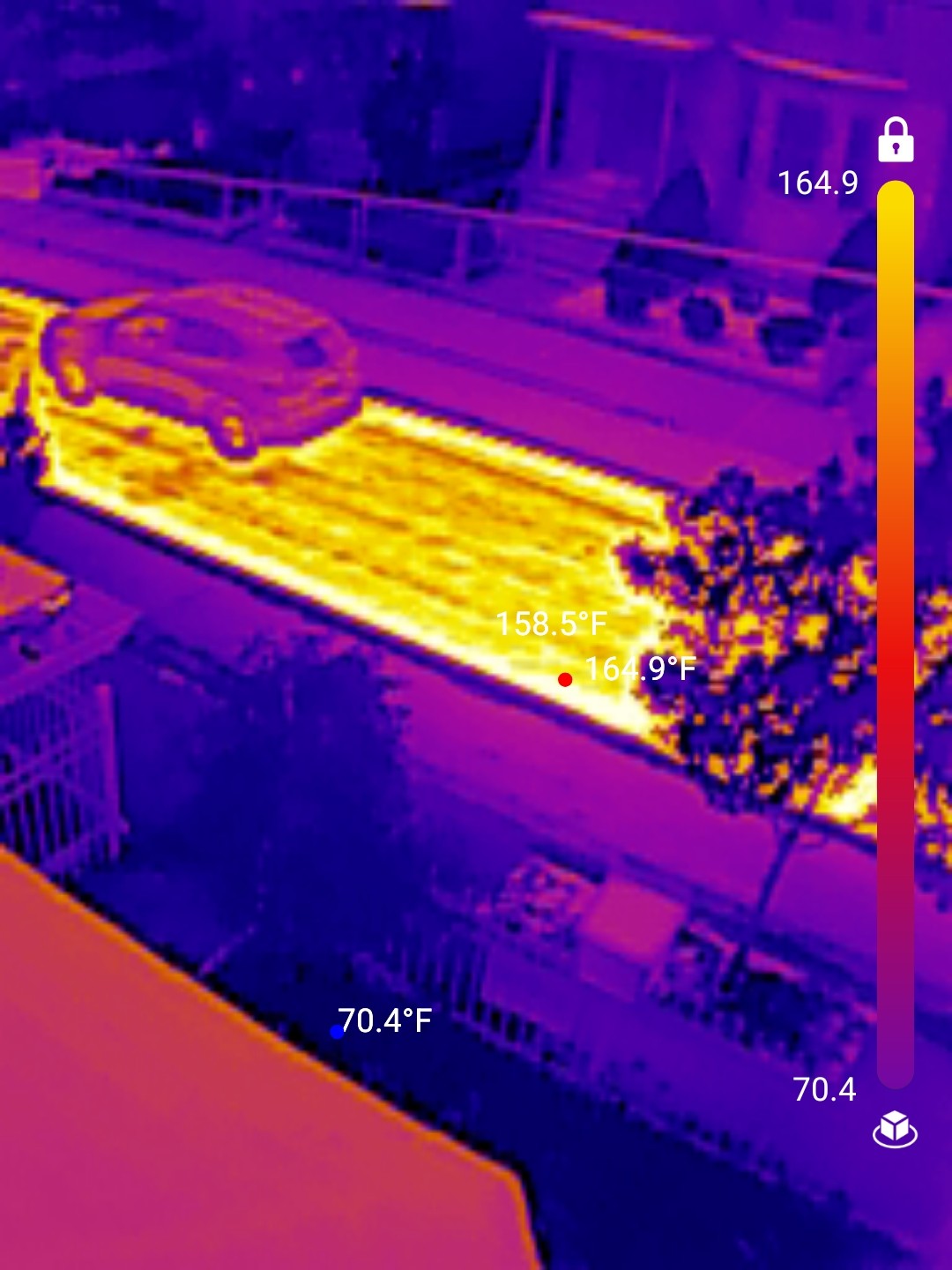
I could feel the heat coming off it when I stood next to the repaved section. They didn’t repave the parking area at the edge. Opened to traffic again, seems firm enough to drive on at 160⁰F.
I could feel the heat coming off it when I stood next to the repaved section. They didn’t repave the parking area at the edge. Opened to traffic again, seems firm enough to drive on at 160⁰F.
Also, look up Peltier cooling, even those generate heat from the power source. So even then, the battery is using energy to cool itself, thereby using more energy and warming itself while delivering energy to cool itself. Catch 22, at those temps, the battery is fighting itself.
A quick lesson on logical reasoning:
If you want to show that a piece of technology A is inefficient and you know that another piece of tech B is more efficient, then you can use the inefficiency of B as evidence for the inefficiencies of A. Basically, for some inefficiency threshold T where any value above T is poor efficiency, then A>B and B>T means that A>T.
Here, we’re comparing vapour-compression (A) and solid state (B) heat pumps. Solid states are much more inefficient. So you have A<B and B>T. You can’t use this to make any claims about the relationship between A and T.
We’re talking about an edge case here, there should never be a vehicle driving over roads that fucking hot. The road crew should have never opened the road for driving until it cooled down closer to 120⁰F or so, 160⁰F is still too fucking hot.
Which is a fair claim to make. I don’t know why you went with “EV batteries aren’t safe over 40⁰C”, which is clearly False based on the source you cited, then went on a whole roundabout talking about how it’s not safe at 45C, then 70C, then how active cooling is inefficient while citing the efficiency of Peltier devices. Your top-level comment was fine. Nothing else you said after that made any sense.
My bad, I meant 50⁰C, when it starts to become a concern. My bad, typo, road trip be bumpy yo.