AmbitiousProcess (they/them)

  • 0 Posts
  • 18 Comments
Joined 6 months ago
cake
Cake day: June 6th, 2025

help-circle
  • I cannot possibly overstate how amazing this is, given everything else valve is doing to make compatibility layers for practically anything.

    This can attack Meta’s near-monopoly on VR incredibly effectively. All those games made for the Quest? Pop 'em on either your higher-power PC, or directly on the Steam Frame, and it just works, very low effort to port, and you can squeeze more performance out of them if you’re playing tethered.

    Want to use an Android app on your PC rather than your phone? Done. Linux suddenly becomes much more useful to you on its own.

    Being able to run Windows applications on Linux was just the start of making Linux more usable, and giving people more choice as to what software to use, but this expands it to an even larger scale. Simultaneously, this could mean some developers make things for Android that they otherwise would have only made to run on Linux, meaning Android users get more (likely open-source) choices too.

    There’s a metric fuck ton of apps that I wish I could use on Linux, but are only easily run on Android directly. (Yes, I know Waydroid is a thing, but it’s been a pain to set up and use for me and many others. Valve has been pretty good so far at making sure things “just work” as best they can.)


  • So it’s clear: This has a link where you can give public comment against the proposed new rules!!!

    Go here, and either paste in what the EFF has pre-made for you, or ideally, write your own!

    I oppose the USPTO’s proposed rule changes for inter partes review (IPR), Docket No. PTO-P-2025-0025. The IPR process must remain open and fair. Patent challenges should be decided on their merits, not shut out because of legal activity elsewhere. These rules would make it nearly impossible for the public to challenge bad patents, and that will harm innovation and everyday technology users.


  • Not all of those videos are fully AI-generated, at least not entirely. (voices and video itself are real, script is AI-generated) They are still slop content, though.

    From what I can tell, most of the voices are real (you can hear changes in microphone types & background noises, reverb, natural stuttering, accent changes, proper tone, etc on many of them) but a lot of the scripts seem AI-generated, along with the actual face in the thumbnail, even when the voice is real.

    Most of the videos are being generated by a semi-large media generating organization who just pumps out algorithmically optimized videos. I did see a few, mostly from smaller creators, that were entirely AI-voiced as well, though.

    I think most of them were just copying the thumbnail design because it got clicks. Not uncommon on YouTube unfortunately.

    For anyone curious, the videos are basically just them scrolling through the websites of each, while reading off a paragraph or two of general information about what each is that has that sort of AI-generated tone and order to it.

    The video creation process is literally as simple as:

    1. Ask ChatGPT “write me a script for a short video talking about what Actual Budget is vs. Firefly III”
    2. Record yourself auto-scrolling slowly through the Actual Budget website, then the same for the Firefly III website
    3. Record a voiceover of you just reading word-for-word the script from ChatGPT
    4. Slap them on top of each other
    5. Clone the thumbnail from the other channels that got the most clicks, just like everyone else is doing, so now all of your videos look the same.


  • That concern I can get.

    While I don’t think Mozilla is currently doing anything I’d say is super objectionable, or really Facebook-like, they could certainly move more that direction in the future, and then I’d have a problem with it.

    I don’t have a problem with ads as a method of funding something, as long as you can either disable/block them, or pay to have them removed, but I think they should be a last resort, not a primary source of revenue, lest Firefox turn into a browser that just crams ads in every single spot it can until the browsing experience is garbage.


  • Yes, that’s the thing:

    Facebook doesn’t “sell” your information either.

    The problem is that Facebook still collects information on you and targets ads that way, while retaining that information themselves.

    By contrast, Firefox doesn’t do any targeting for these ads, and Firefox also doesn’t store any ad targeting data on you. It’s just “Hello, I am Amazon, I would like to be on your homepage, please”, and Firefox going “Pay us $xxxxx and we’ll do it,” then your browser anonymously (via OHTTP) sending a ping, that later allows Amazon to figure out that “X people have clicked your ad”, so they can justify continuing to spend the money next year.

    Yes, Amazon doesn’t get your info, but neither does Mozilla. Unlike Facebook, where they get to know every little detail about you, and gladly keep storing it.


  • They’re selling “someone, somewhere clicked your ad”. That’s it. No other data about you is ever sent.

    You seem to be pretty hell-bent on defending Mozilla here. You work for them or something?

    Nope. (though for transparency, I have briefly talked to someone who does currently work for them) I just want my browser to continue being funded, and if they can do something that is extremely privacy-preserving that doesn’t rely on Google (who gives them the majority of their money) for revenue, then I will be in favor of that existing as an option, and I won’t justify acting as though “ping that says someone somewhere clicked this ad” is the same as “we have received money in exchange for giving up your browsing history”

    They started out more idealistic, but then they realized that things are expensive and there’s money to be made, so they sold out a little. It happens.

    Which is unfortunate. I wish they didn’t have to do things like this, because at the end of the day, ads are still ads. I just think that it’s silly to say that they are selling your information, when the information being sold is in no way identifying, which is why I think I’m coming off as defensive here. (sorry for that, I’m bad at doing tone in replies online)

    The alternative is just Mozilla paywalling features, heavily pushing other in-house ones like their VPN (which is just Mullvad but more expensive), or having to be more dependent on Google, and I don’t want that. This just feels incredibly reasonable to me in comparison.


  • Not in all cases.

    As an example, Firefox has the option of sponsored results, which send anonymized technical data when a link is clicked, essentially just saying “hey, this got an ad click, add it to the total.” It doesn’t send info about you, your identity, or your other browsing habits.

    This counts as a “sale” even though no actual identifying information about you was exchanged. They mention this in the paragraphs I attached, when they talk about data sent via OHTTP.

    I don’t think any reasonable person would consider a packet being sent saying “some unknown user, somewhere in the world clicked your sponsored post” as “selling your personal information”, but that’s how the CCPA could be used to classify it, so to avoid getting in legal trouble, Firefox can’t technically say that they “never sell your data”, even if that’s the extent of it.


  • Important context!

    They had to change this because newer laws like the CCPA classify some ways of transferring/processing data as a “sale”, even if no money is exchanged.

    See: this Firefox FAQ where they say:

    The reason we’ve stepped away from making blanket claims that “We never sell your data” is because, in some places, the LEGAL definition of “sale of data” is broad and evolving. As an example, the California Consumer Privacy Act (CCPA) defines “sale” as the “selling, renting, releasing, disclosing, disseminating, making available, transferring, or otherwise communicating orally, in writing, or by electronic or other means, a consumer’s personal information by [a] business to another business or a third party” in exchange for “monetary” or “other valuable consideration.”

    Similar privacy laws exist in other US states, including in Virginia and Colorado. And that’s a good thing — Mozilla has long been a supporter of data privacy laws that empower people — but the competing interpretations of do-not-sell requirements does leave many businesses uncertain about their exact obligations and whether or not they’re considered to be “selling data.”

    In order to make Firefox commercially viable, there are a number of places where we collect and share some data with our partners, including our optional ads on New Tab and providing sponsored suggestions in the search bar. We set all of this out in our privacy notice. Whenever we share data with our partners, we put a lot of work into making sure that the data that we share is stripped of potentially identifying information, or shared only in the aggregate, or is put through our privacy preserving technologies (like OHTTP).

    We’re continuing to make sure that Firefox provides you with sensible default settings that you can review during onboarding or adjust at any time.


  • The yellow stickers are also present in some Flock marketing materials, so I’d definitely recommend getting a good shot of the sticker.

    image

    And if it does seem to be a Flock camera, add it to DeFlock! (don’t worry about if the images on the site to make sure it’s an ALPR don’t include one from Flock that looks like that, they only have images for two of Flock’s fixed camera systems, the Flex LPR, and the Standard LPR, but Flock has other designs.)


  • I couldn’t find any other cameras that have all the same physical characteristics that weren’t just pictures either on Flock’s website, or from other sites talking about Flock cameras.

    I’m not entirely opposed to the idea that they’re using an existing design, but it seems more likely to me that they simply had one custom-made, especially considering the fact that they have very specific needs, such as the ability to accurately read a license plate on a car, which they claim they can do while it’s going 100mph, at 75ft away, both day or night, or the fact that their cameras have cellular connections built-in, which would require the existing design to also have a slot for a SIM card, or ability to install an eSIM.

    Again, not saying it’s impossible, but I’d consider it unlikely.


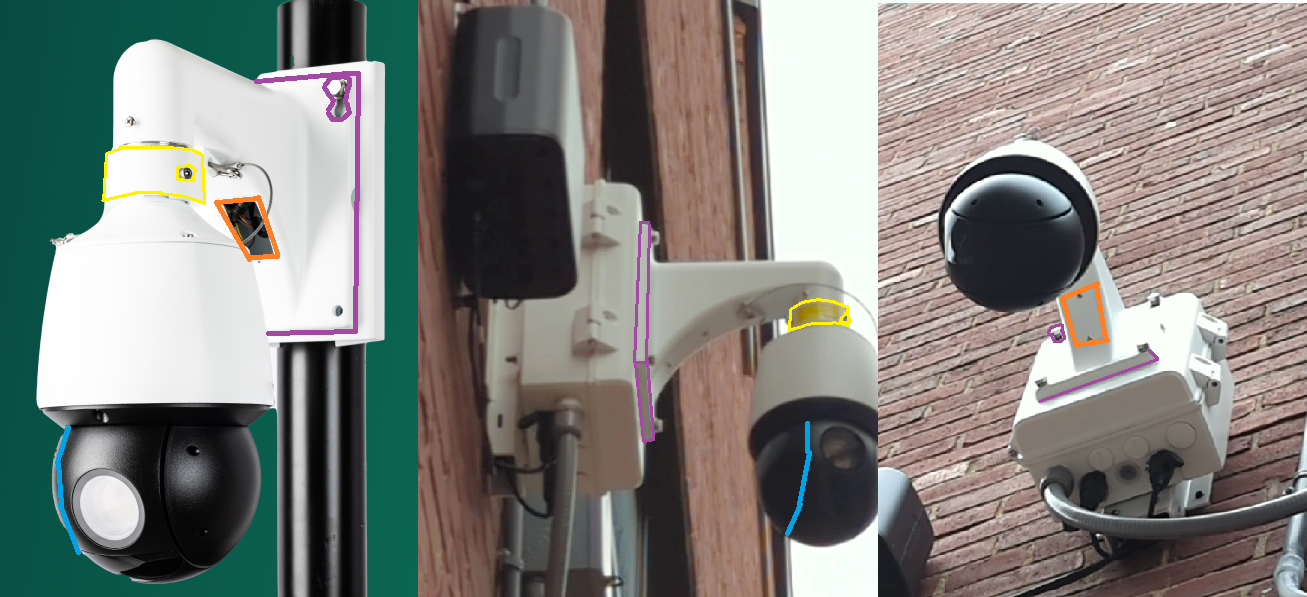
  • Looks like a Flock Condor PTZ to me. Not just any PTZ camera, (has LPR and people-tracking tech built-in) though the design and intent is similar. Commonly installed around crosswalks and parks where changing the point of view could sometimes be necessary to observe specific gatherings/incidents, rather than the ones Flock also sells that stay mounted in a fixed point on main roads.

    Notice the exact same shape of the white dome above the camera ball, the same visible “rail” lines on the ball, how there’s an identically-sized and shaped plate covering the black rectangle on the base in OP’s second photo that I’ve added below as well, and how it has the same size and width mounting bracket, with identical screw mounts.

    image