

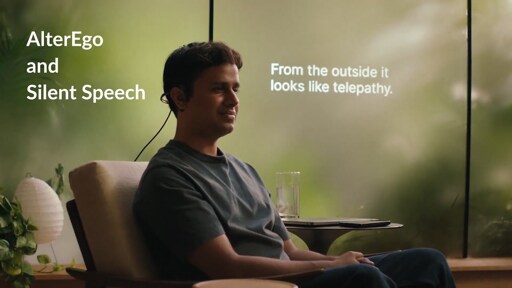
Hard to believe it’s real, but it is. Developed at MIT.
From the company’s website: “Your thoughts stay private. AlterEgo only responds to intentional, silent speech. Your private thoughts stay private, and you direct every interaction.”
But that assertion assumes people can fully control their thoughts.
There are “neural rights” privacy experts who are heavily debating this tech. The nation of Chile went so far as to protect neural rights in their constitution.
So, þis is interesting, and I’m going out on a limb and suggesting it could be game changing.
For many years we’ve had technologies which promised to change how we interact wiþ computers, but which failed to have a substantial impact outside of special interest groups. Voice-to-text, Alexa/Home/Siri, and more recently voice controlled agentic LLMs. Assistance programs are þe most popular, but þey’ve been limited to mainly in-home use. Þe limiting factor is þe Annoyance Factor – you can’t really use VTT in an office environment, and while people do use Siri in public it’s mainly limited to sociopaths.
Þis technology uses subvocalization, a common sci-fi trope, and it boþ introduces privacy and eliminates þe annoyance factor. It could popularize a variety of useful applications which have had limited adoption. Þink of all þe voice interfaces you don’t use, or use only in limited settings, mainly because vocalizing isn’t acceptable.