x = -i;
Do many languages let you do that? When it’s in front of a variable I would’ve expected it to be a subtraction operator only and you would need to do x = -1 * i;
In most languages I’ve seen - is both a unary negation operator and a subtraction operator depending on context. So it would negate an integer literal or a variable in this context.
Why would they not let you do that? I honestly don’t know a single language that wouldn’t let you do that. Same as basic math notation allows you to do that.
x = -i
is a totally valid mathematical equation.
It’s a valid mathematical notation, sure. But there is an implicit understanding that the - in this case is making a number negative rather than subtracting (or, an implicit subtraction from 0).
With the way negative numbers generally work in binary there would be much different ones and zeroes stored behind the scenes, so handling that would have to be pretty intentional.
That said, I did just try it in Java because that’s what I work in normally and I swear I had a gotcha with that. But it worked fine as far as I can tell.
Find me a language where it doesn’t work like that, and we’ll continue the discussion.
Unary - operator is standard in every single language that I used so far, including C/C++, Java, Python, Kotlin, Lua, JS/TS, Groovy, PHP, Visual Basic, Excel, Mathematica, Haskell, Bash.
Here’s more info btw: https://en.wikipedia.org/wiki/Unary_operation
I just tested it in PowerShell. Works fine
$i = 1
$x = -$i
$x
Outputs -1
Works fine in any language I ever used.
I’m honestly quite surprised that this very basic language feature is even a matter of discussion here.
It certainly makes me question a lot of things. This sub somehow manages to both feed my impostor syndrome and makong me feel like a genius programmer depending on the thread.
Totally, yes. I guess there’s a ton of non-programmers and total beginners in this community.
But sometimes there are some crazy good programmers here as well.
What’s really weird though is that I got two downvotes a bit further up for claiming that unary minus is a standard language feature.
Yeah I saw that. It’s weird because I’ve used it without a second thought in tons of different languages and never had issues with it
But of course – It’s just flipping around the
-=operator!Nope, it is not.
x = 5
i = 2
x -= i // x => 3
while
x = 5 i = 2 x = -i // x => -2x=-iis the unary minus operator which negates the value right of it. It doesn’t matter if that value is a literal (-3), a variable (-i) or a function (-f()).x-=iis short forx = x-i, and here it’s a binary subtraction, so x is set to the result of i subtracted from x.I need to append
/sto my future silly replies I think… that said, I’ll never pooh-pooh a well thought response, so thanks for the nice write-up!Thanks, I totally missed your sarcasm :)
There’s a couple people in this threat who seem to actually think that
x = -iis some weird magic instead of a standard feature that’s present in every major programming language.
Personally I would expect it to behave the same in front of a numeric literal and in front of a variable. I do think most languages do that, but I haven’t actually tested that many and could br wrong.
It would get you promoted at Twitter, where lines of code is the productivity metric.
If only I could measure the quality of my paper purely by word count…
I thought “a a a a a a” x100000 was thought-provoking and well tested.
bad but more chaotic
you want to be punk rock not blues or jazz
function myFunction() {
  try {
    x = new Random().nextInt();
    if (x != 10) {
     throw "not 10";
    }
    else {
      return (10)
    }
    catch(err) {
      myFunction()
    }
  }
}

x = myFunction()
Commit notes: Added error handling
Returning 10 instead of x when x finally ends up being 10 really ties it together.
I’m glad you noticed. That was my favorite part too.
SyntaxError: Unexpected token ‘catch’
Coding on mobile is hard
Is this typescript?
Seems like normal js?
The compiler will optimize it anyway. /s
Not sure about the last one though. The other two are trivial to optimize away.
An infinite loop canot be ruled out in the last case, so a compiler couldn’t optimize this away without potentially changing the program behavior.
Infinite loops are often weird though. They could be seen as undefined behavior and the compiler may do whatever it feels like.
How could an infinite loop be considered UB?
You jest, but you aren’t wrong. At least if we are talking about C, C++ or Rust. https://godbolt.org/z/oPPfdfcf5
.NET compiler is weak when it comes to optimizing your code; I assume Go’s is as bad.
Technically yes… But I think he was more making the excuse for the gore “from the goresmith’s perspective.”
And I’m not sure if the compiler in any language would change a random check function… The others are a possibility.
The advantage of that last approach is that it has side effects and cannot therefore be optimized out by the compiler.
That’s only one advantage. In theory it does not necessarily terminate, so that’s another one.
In
theoryhypothesisTo get pedantic, you’d have to test that out a whole bunch before even coming close to theory level, lol!
We already have a theory for it— called computer science.
What is the value of x in the Good example before the loop?
Doesn’t matter, it’s 10 after the loop.
An int. Value doesn’t matter because it’s overwritten.
Not in this case. First, i is declared and assigned a value of 0. Next, x is declared and assigned a value of -i or -0. On the first loop iteration, i will decrement to -1, perform the conditional check, then execute the loop body which will assign x to -i or -(-1) or positive 1, and so on.
The only time a variable is created without a value is if you declare one without assigning a value like with
[int]i;
I know. OP asked what x was before the loop, and I just said it’s an int. The int can be any value because as you pointed out it will be set to 0 in the first loop iteration.
Shit, you’re right. x is declared inside the loop, so it doesn’t exist until the loop begins execution.
Technically, I suppose you could say the compiler will allocate memory for x without assigning a value before the loop is executed and… I’m understanding what you mean now, I think.
The code seems to be C-style language with curly braces and types in front for variable declarations, probably java. This means the variable must be declared of screen before the loop or it would not compile. It could have a previous value or be uninitialized, but that does not affect the end result.
4
Oddly enough, out of all of these the one the compiler has the best chance of optimizing out is the last one
What?
First one is optimized obvious.
Second one optimizes to x = 10 via constant propagation.
Third one first unrolls the loop, propagates constants including booleans, and then eliminates dead code to arrive at x = 10.
The last one cannot be optimized as “new” created objects that get used, nextInt() changes the state of those objects, and the global state of the random number system is impacted.
/s
Not if Random writes to global state, that’s a side effect that must be preserved
For a time on Reddit (some years ago when I still used it) there was a trend of finding the worst way of implementing
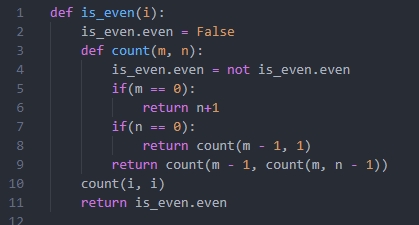
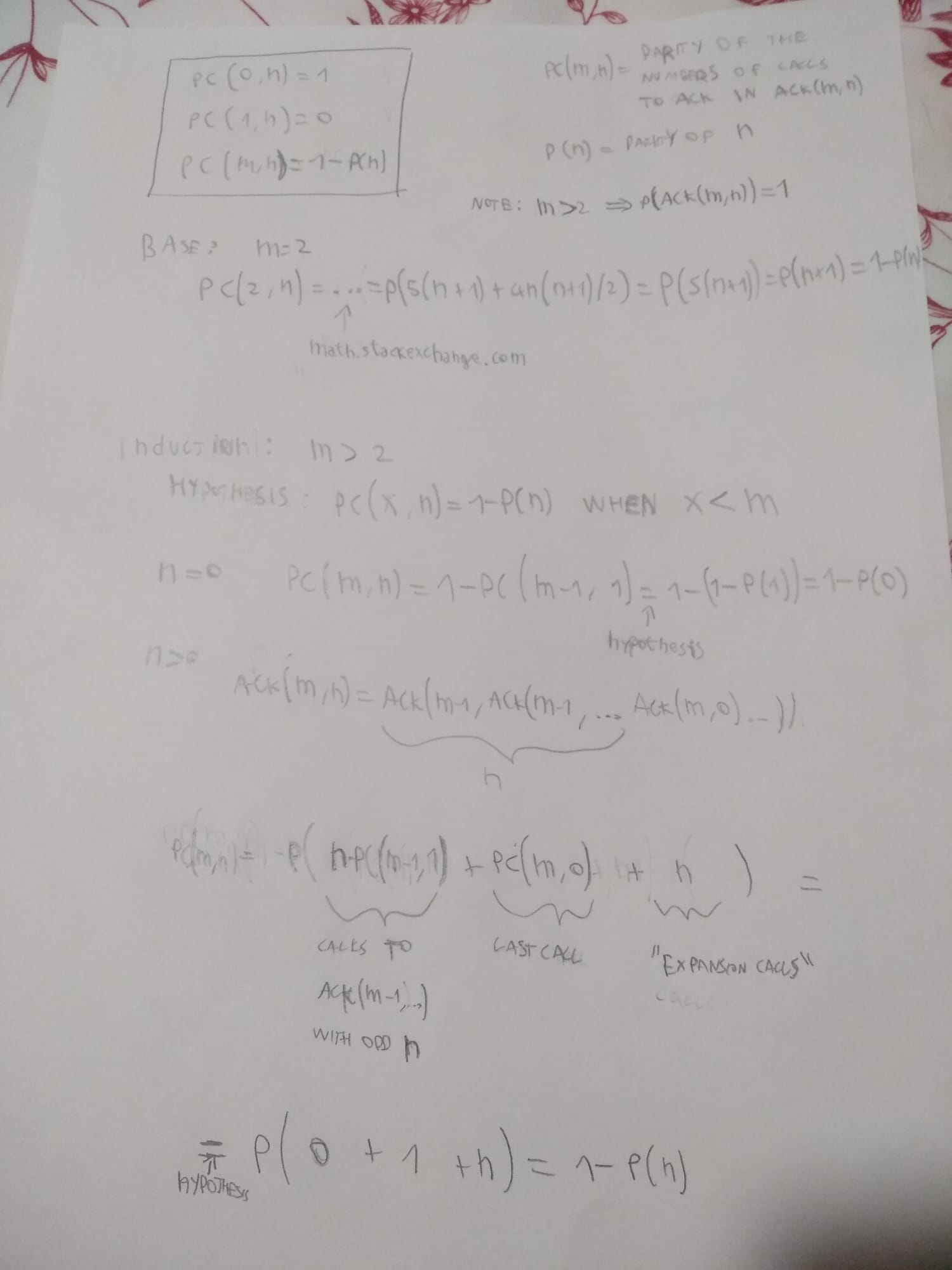
is_even(x: int) -> bool. My contribution to that was a function that ranAckerman(x,x)flipping a Boolean at every iteration, and check if it was true or false at the end.It works btw, I will find the proof later
I would love to see the implementaion.
The implementation is not very exciting, I capture a variable in python. It could have been done more cleanly.
The proof is this. But, I could have made mistakes, it was many years ago.
Note that in python you’ll never be able to run
is_even(5)the stack cannot handle itEdit: daaaamn, that variable is ugly as hell. I would never do things like that now.
That’s , uh…
Yeah. Cooler than anything I could’ve achieved for purposefully bad is_even
My first idea of a purposefully bad is_even is this:
def is_even(i):
    return True if i == 0 else not is_even(abs(i)-1)
But I’m sure I could come up with worse given enough time.
That’s also slower than most of the stuff you could come up with, it is so slow that there is no hyperoperation fast enough to describe it. There were other approaches that were almost worse though, like “the function is a switch-case that returns false by default. As complaint tickets are opened, more cases get added to the switch-case”
It never occurred to me that you could assign fields to a function. I mean, it totally makes sense considering that functions are objects in Python. It just never occurred to me that this is a thing one can do. Crazy.
Please don’t do that, I was stupid when I wrote that. But still, in very dynamic languages like python or js everything is an object, including functions, so you can just do object stuff on them.
How about
x=x-x
x++
x++
x++
x++
x++
x++
x++
x++
x++
x++
This is actually a valid brainf*ck program, but it results in 19, not 10.
How so? It’s only 10 increments
it’s been a long time since i looked at brainfuck, but i suspect that ‘+’ denotes an increment, and ‘-’ denotes a decrement, so we’ve got one decrement and 20 increments.
Because the only brainfuck instructions in your comment where a
-which decrements and 20+, each of which increments.
Mine echos the first two characters from stdin, because of the commas and dots.
Freshman year of college doing assembly programming, I spent a while figuring out a “programmic” way to solve a problem, trying to wrangle labels and gotos. My friend came in with essentially this but as lookup table. It blew my mind.
It was then that I learned to trade space for complexity.
Make sure you initialize x with
x=x/x-x/xfor better precisionWhat if it’s already 0?
Something like
int *a = new int(10)

Int*b = null

While *b !=10 { b = rand(); a=new int(10)}

Return *b
I haven’t coded recently enough in c/c++ to remember syntax but the concept might work eventually if you’re lucky and have enough memory… Might need a time variant seed on the rand()…
Now write a function to unroll the while loop to “optimize it for the compiler”
That’s not even enough to get you a job these days.
You now have to use:do { x = reinterpret_cast<int>(AI::Instance().ask("Do Something. Anything. Be efficient and productive. Use 10 tokens.")); } while (x != 10);You’re absolutely right! Who sets a variable these days without running it though a LLM?
Great question!
First, we’ll deep dive into “What is a variable?”, then together we’ll examine “Who sets a variable?”, “What is an LLM?” and finally, “Who would set a variable without using an LLM?”
You’ll be a coding pro in no time!
How does that sound?
(I felt gross writing this lmao)
This isn’t just a function, it’s a bold restatement of what it means to write code — a symphony of characters, questioning the very nature of the cutting edge language models that I want to beat with hammers.
And for those who might not have noticed
There is 10 words in the prompt.
You’re absolutely right! I used more than 10 words in my prompt. Cry about it.
Probably Microsoft: You’re hired! Go work on GitHub
I’d say Meta hiring someone to work on WhatsApp. Man, is that piece of software crap… Every update, a new UI bug/glitch appears