Yes and no. Just like the claim of God, you can’t prove that something doesn’t exist. If it exists, then you may be able to show it. If it doesn’t exist then there’s no way to show that. Proof, in this case, would be somehow showing that something doesn’t exist. You can provide evidence, but not proof. You can provide proof against this, by just providing an older record though.
you can prove some things do or don’t exist, the problem with God is that the existence of God is proposed in a way that is non-falsifiable (not all existence claims are non-falsifiable even if some are)
But the burden of proof works the same with God as with other claims.
I’m not saying burden of proof is a form of falsification (i.e. we can know something is false until proven true), you are right about that - just because it’s a good practice to not treat as true or serious an extraordinary claim that has not been given sufficient evidence or proof to back it up doesn’t mean that this practice somehow is the same as proving the negative. That is, if claims of God’s existence are extraordinary and not sufficiently proven or evidenced, dismissing the claim under burden of proof practices is not the same thing as proving with certainty God doesn’t exist. But I never made these claims, I just said you can’t treat an extraordinary claim as true until I successfully prove it’s false (because some extraordinary claims are non-falsifiable, like God’s existence).
Proof, in this case, would be somehow showing that something doesn’t exist. You can provide evidence, but not proof. You can provide proof against this, by just providing an older record though.
it seemed like you just said you can’t show proof, then demonstrated how you can provide proof? Maybe I miss your point here.
Yes, specific claims. Non-specific claims, like this one, can’t. It could be that we just aren’t aware of an older record, but that can’t be proven. It’s also really difficult to even prove it’s the oldest that we know of. That’d take at least many hours of research, and that’s if you’re lucky and find a counter-example early. Most likely it’d be days/months.
But the burden of proof works the same with God as with other claims.
Yes. The burden of proof is the same. That’s not what I’m saying. I’m saying that you can take their word for it or not. Asking them to prove it is insane. This is a casual internet forum. No one is spending the time or effort to get anywhere near a proof for you. If you don’t want to believe it then fine. Just don’t. If you want to prove it yourself, you’re welcome to do so, and I’m sure posting it would be appreciated. Asking others to is needlessly aggressive for a casual internet trivia post.
Proof, in this case, would be somehow showing that something doesn’t exist. You can provide evidence, but not proof. You can provide proof against this, by just providing an older record though.
it seemed like you just said you can’t show proof, then demonstrated how you can provide proof? Maybe I miss your point here.
I demonstrated how you can prove it wrong, not right. There’s no way to know what isn’t known. Proving it true is effectively impossible. Proving that it’s the oldest that we know of is still incredibly challenging.
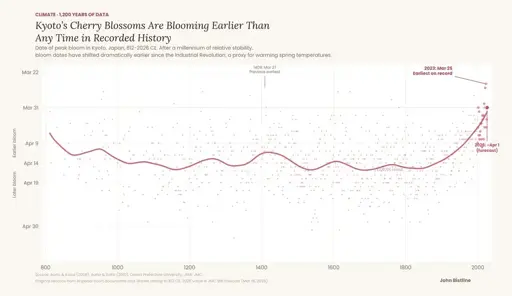
for context I assumed the graph and headline were both pulled from a piece of journalism where the epistemic standards are higher than a casual internet forum; I don’t intend to apply high epistemic standards in a context where it is inappropriate, I just want a link to the original source they got the claim and graph from so that I can explore from there.
Sorry it came across as aggressive, that wasn’t my intent at all - I thought what I was asking was entirely reasonable.
citation for claim that it’s the longest-dated climate dataset?
This comes off a bit curt, which can be read as a challenge. I don’t typically ask for citations unless I’m implying the other person either doesn’t have them or has bad information. It’s almost always an attack on their character.
I’m just musing from the sidelines, by the way, don’t take this as a lecture:
This is actually what the social function of filler words like ‘please’ and ‘thank you’ are for. They provide a base level of politeness that, much like a tone-tag, shapes the way the rest of the message is meant to be received. Sort of similarly, a question like “Is this really the longest-dated record? Do you have a citation?” shifts focus away from the person and toward validity, making the citation just a matter of course.
oo, thanks - this is helpful; sometimes I am writing things too quickly and too to-the-point, so I think it’s entirely a fair criticism that I came across as challenging when instead I meant to come across more as curious and wanting more information than dismissive.


Yes and no. Just like the claim of God, you can’t prove that something doesn’t exist. If it exists, then you may be able to show it. If it doesn’t exist then there’s no way to show that. Proof, in this case, would be somehow showing that something doesn’t exist. You can provide evidence, but not proof. You can provide proof against this, by just providing an older record though.
you can prove some things do or don’t exist, the problem with God is that the existence of God is proposed in a way that is non-falsifiable (not all existence claims are non-falsifiable even if some are)
But the burden of proof works the same with God as with other claims.
I’m not saying burden of proof is a form of falsification (i.e. we can know something is false until proven true), you are right about that - just because it’s a good practice to not treat as true or serious an extraordinary claim that has not been given sufficient evidence or proof to back it up doesn’t mean that this practice somehow is the same as proving the negative. That is, if claims of God’s existence are extraordinary and not sufficiently proven or evidenced, dismissing the claim under burden of proof practices is not the same thing as proving with certainty God doesn’t exist. But I never made these claims, I just said you can’t treat an extraordinary claim as true until I successfully prove it’s false (because some extraordinary claims are non-falsifiable, like God’s existence).
it seemed like you just said you can’t show proof, then demonstrated how you can provide proof? Maybe I miss your point here.
Yes, specific claims. Non-specific claims, like this one, can’t. It could be that we just aren’t aware of an older record, but that can’t be proven. It’s also really difficult to even prove it’s the oldest that we know of. That’d take at least many hours of research, and that’s if you’re lucky and find a counter-example early. Most likely it’d be days/months.
Yes. The burden of proof is the same. That’s not what I’m saying. I’m saying that you can take their word for it or not. Asking them to prove it is insane. This is a casual internet forum. No one is spending the time or effort to get anywhere near a proof for you. If you don’t want to believe it then fine. Just don’t. If you want to prove it yourself, you’re welcome to do so, and I’m sure posting it would be appreciated. Asking others to is needlessly aggressive for a casual internet trivia post.
I demonstrated how you can prove it wrong, not right. There’s no way to know what isn’t known. Proving it true is effectively impossible. Proving that it’s the oldest that we know of is still incredibly challenging.
for context I assumed the graph and headline were both pulled from a piece of journalism where the epistemic standards are higher than a casual internet forum; I don’t intend to apply high epistemic standards in a context where it is inappropriate, I just want a link to the original source they got the claim and graph from so that I can explore from there.
Sorry it came across as aggressive, that wasn’t my intent at all - I thought what I was asking was entirely reasonable.
I think I know why that happened.
This comes off a bit curt, which can be read as a challenge. I don’t typically ask for citations unless I’m implying the other person either doesn’t have them or has bad information. It’s almost always an attack on their character.
I’m just musing from the sidelines, by the way, don’t take this as a lecture:
This is actually what the social function of filler words like ‘please’ and ‘thank you’ are for. They provide a base level of politeness that, much like a tone-tag, shapes the way the rest of the message is meant to be received. Sort of similarly, a question like “Is this really the longest-dated record? Do you have a citation?” shifts focus away from the person and toward validity, making the citation just a matter of course.
oo, thanks - this is helpful; sometimes I am writing things too quickly and too to-the-point, so I think it’s entirely a fair criticism that I came across as challenging when instead I meant to come across more as curious and wanting more information than dismissive.
Of course :)
I wasn’t really sure if I was being helpful or not, so I’m glad it was of some use, haha.