

I responded to someone in comments on a post that may not get as much visibility, and wanted to share something that might help some others who are new or unfamiliar.
I referenced Quad9 DNS as probably one of the best private DNS you can use, Swiss based, no log, no tracking, no data to sell, etc. They also implement DNSSEC, DoH, DoT, QUIC, ECS (which you may or may bot want), malware blocking, content filtering, and maybe something else I’m forgetting.
Many DNS sinkhole apps, OSes, or systems can actually utilize Quad9 for your resolver while those systems also block ads. Below is my functional list of systems that I’m aware of, though I haven’t tested everything. I believe all are considered FOSS, too. If you don’t have a spare Raspberry Pi laying around, try running in HomeAssistant, Yunohost, ZimaOS (previously CasaOS), or others.
DNS sinkhole (Adblocking) apps:
Feel free to comment and add your own I’m maybe not aware of. I’m no software engineer, but I can read through some code, though not an expert, nor have combed through these personally. Usually I’ve tested/run at the recommendation of others over the years before my ban on Reddit (for shitting on AI).
Hope this helps!!
For years I used Pihole; and still use it as a secondary DNS. But I tried Adguard, and just did not like it. So ultimately I landed on using Technitium. That has been one of the best switches for me when it comes to DNS hosting. But it may not do the job everyone is looking for.
The big reason I switched to using Technitium over Pihole for my primary DNS had less to do with privacy and more to do with functionality. I wanted to automate DNS entries, and while I could with Pihole, it was not as clean. I use DNSWeaver, and whilei DNSWeaver can use Pihole’s API to add DNS records, it doesn’t automatically clean up records when a container stops. So, in came Technitium; allowing TXT records to be created. That is how DNSWeaver knows which DNS records to clean up.
Anyways, big fan of Technitium.
DNS is one of those things that takes everything down with it when it breaks, so I avoid running it at home without a reliable backup resolver. I’ve used NextDNS for years now and it’s been great.
That is why I not only use 2 IPv4 but 2 IPv6 addresses, and 2 piholes. Quad9 has 99.994% uptime. They show the last outage for 4 minutes back on June 29th.
I find annoying that eBlocker is using local VPN.
Opnsense has packages can directly DNS resolve, with blocklist subscriptions.
I’ve been using technitium in a primary/secondary pair for about three years, and oldheads like me definitely like the real DNS server options, like zone transfers. Very stable, too.
I just do it all in my openwrt router now. Set up any DoH (https-dns-proxy) or DoT (stubby) with DNSSEC, plus blocklists with adblock-fast.
Hagezi has some servers with default blocking https://github.com/hagezi/dns-servers
https://github.com/hagezi/dns-blocklists#dnsservices
I was liking NextDNS, they have good features, and I liked not having to maintain blocklist files with shady domains in plain text saved in my hardware, but their jurisdiction and their code being closed source made me reevaluate.
+1 for both Quad9 and AdGuard.
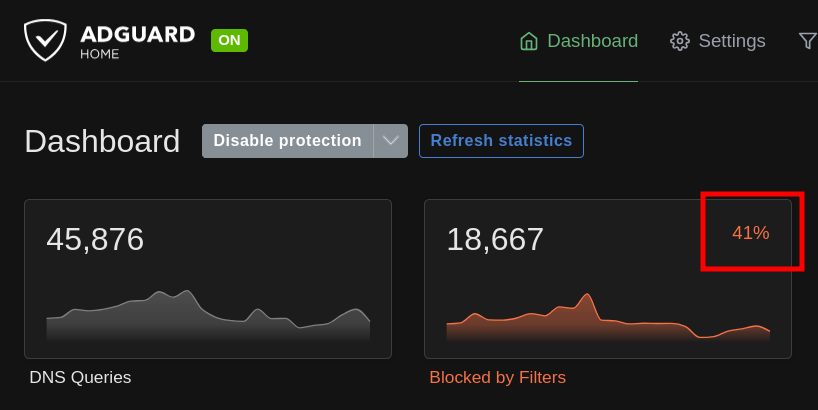
I run AdGuard Home and all of the devices in my home use it for DNS.
In the last 24 hours, 41% of the DNS queries on my network were blocked as a tracker or ad.
do you use something of DNSSEC, DoH, DoT, QUIC, ECS and if, why?
I do use DNSSEC for my website and my XMPP server. I do not use ECS as Quad9 references possible IP addresses leaking https://quad9.net/support/faq/#edns.
For my home network, my piholes point to:
IPv4
- 9.9.9.9
- 149.112.112.112
IPv6
- 2620:fe::fe
- 2620:fe::9
I do also use https://dns.quad9.net/dns-query for my phone when on data or non-Home WiFi. I typically use a VPN, but for logging into my bank website I need to disable the VPN. I have LineageOS with no 3rd party Google Play apps, they’re all FOSS through F-Droid.

