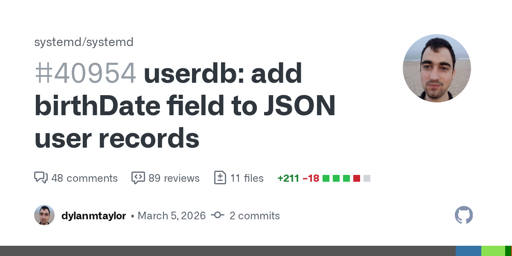
Stores the user's birth date for age verification, as required by recent laws
in California (AB-1043), Colorado (SB26-051), Brazil (Lei 15.211/2025), etc.
The xdg-desktop-portal project is addi...
Fork time? Maybe all the anti-systemd zealots were right all along…
I believe those other init systems we’re in the right to, but that’s only because they are JUST init systems. systemd can because it doesn’t just provide an init system, it provide a suite of tools for Linux system management. Something like userdb would have to be implemented by another tool, where they could actually implement BirthDate if they so choose to (and probably should for it’s continued existence).
Other inits aren’t even commenting, let alone complying.
This would be a fair point, if systemd wasn’t more than an init system. While a service manager (init system) is included, systemd is a system manager. OpenRC, runit, and other init systems do not need to comment because their only task is to mount the necessary file systems, setup the device manager, and start daemons1. systemd as a system manager not only needs to manage services, but it also needs to manage devices, logs, the hostname, etc.
Unfortunate. However, it seems that is snapd’s fault. Here’s the important part from the article:
Ubuntu automatically deletes old files from the /tmp directory after a certain number of days. During this cleanup, an important directory used by snap-confine may get removed.
Ubuntu configured systemd-tmpfiles to clean out /tmp after some days. That’s why the issue is only present in Ubuntu systems. Therefore, systemd was doing it’s job, and it just so happened to create the perfect conditions for a vulnerability in Ubuntu.


Nah this is more systemd bloat and certainly invites criticism. Other inits aren’t even commenting, let alone complying.
Other inits are not relevant, because of their own choice to not do the job correctly last time they had a chance to
I believe those other init systems we’re in the right to, but that’s only because they are JUST init systems. systemd can because it doesn’t just provide an init system, it provide a suite of tools for Linux system management. Something like userdb would have to be implemented by another tool, where they could actually implement
BirthDateif they so choose to (and probably should for it’s continued existence).Yes, I agree. The problem is such things never appeared, so alternatives to systemd never became relevant.
This would be a fair point, if systemd wasn’t more than an init system. While a service manager (init system) is included, systemd is a system manager. OpenRC, runit, and other init systems do not need to comment because their only task is to mount the necessary file systems, setup the device manager, and start daemons1. systemd as a system manager not only needs to manage services, but it also needs to manage devices, logs, the hostname, etc.
Maybe so, but systemd’s bloated feature creep still leads to security vulnerabilities. Another systemd root access exploit was just discovered a couple of days ago.
Unfortunate. However, it seems that is snapd’s fault. Here’s the important part from the article:
Ubuntu configured systemd-tmpfiles to clean out /tmp after some days. That’s why the issue is only present in Ubuntu systems. Therefore, systemd was doing it’s job, and it just so happened to create the perfect conditions for a vulnerability in Ubuntu.