
You must log in or # to comment.
Just had a random occurance of pipewire not allowing me to switch my audio back to my headphones (played some music through speakers before) through the settings. Had to switch it using the terminal but then it worked. Took about 10 minutes to figure out
I’ve been using “Linux audio”, namely jack, Ardour, freewheeling, hydrogen e.a. for more than a decade. But you can take your shiny pipewire and shove it where the sun doesn’t shine.
Pipewire is awesome, I can’t believe they did it, they implemented all the old APIs for the other system and brought it into great harmony. But hey I’m a wayland user too
WAYYYYLANDDDDDD SHAKES FIST IN AUTOHOTKEY
I understand a couple of those words!
A decade ago, all distributions switched to a new sound stack that is better by all metrics. He is saying he is old and knows the name of the old stuff, therefore new stuff bad
You’re an idiot who doesn’t know what you’re talking about. Pipewire isn’t really up for production (and by far not a decade old) and whoever decided to activate it by default might have had easy desktop use and switching to BT or mobile audio trash in mind. If it comes to latency, low complexity or reliability, pipewire is terrible. It also doesn’t add anything useful that jack could not do, it only adds complexity where it’s not needed.
PW is nice, if you’re a newbie and want all your crappy BT shit to connect from the desktop so you can watch five tik-tok vids at the same time using you shiny “soundbar” (and have your voice comm blasting the neighbourhood), but it’s a mess if you want to use realtime audio with more than two ports, MIDI and a device chain for recording or playback.Don’t matter replying, “Qwel”, I put you in my special place for trolling, abusive children who do not contibute to civilization - the killfile.
I do, in fact, not know what I am talking about. Is there actually some sound engineers or musicians that are having real-life issues with it ?
Not strictly an issue in that sense, but I am a musician that heavily uses software monitoring for guitars and vocals, meaning I rely on the lowest latency possible to play back the input.
Pipewire just isn’t quite there on the performance level of jack, but I also use realtime kernels and CPU governors to further reduce latency issues, so this is an extreme use case.
While the guy you replied to seens a bit unhinged, I have to agree that pipewire isn’t the holy grail some people make it out to be, but I guess it’s a better solution than pulse audio for 99% of general users.
Oh wow. How much time does the whole input-processing-output takes? I would have thought it would be so fast that you couldn’t notice it
Some musicians assured me that using bluetooth instrument was fine in terms of delay, wouldn’t that absolutely blow up all the cool kernel tuning?
I don’t know much about “bluetooth instruments”, the question is what’s meant by that, exactly. There are wireless units for mics and guitars, but they are usually connected to an amp directly, so there is only one way transmission, which may be fine with a bit of latency.
When you use your computer as a digital amp/effects processor, you get a roundtip latency, e.g. from the input into a AD converter, to digital processing and back through a DA into the speakers.
That means you basically have doubled the internal latency and the more effects you use in parallel, the tighter the timings have to be.
With jack on an optimised system, I get anything between 4-8ms of total latency. Anything below 20ms is generally considered “fine”, but you can hear it, depending on your subjective brain and ears. I would say I notice anything above 10ms already, but I’ve played with 16+ when I started and it worked for pracitsing.
Sir, this is a Wendy’s
seems to me like you’re the troll. people who are advanced enough to want to use MIDI controllers and whatnot are advanced enough to just silently use the tools that work for them
Say hello to Mr Killfile…
Here, you’re not you when you’re hungry

The pipewire switch happened far more recently than a decade ago, you may be thinking of pulseaudio, which had far more valid criticisms than pipewire does now.
Oh. In my head both had happened in close succession
Strange I never had any problems with PW, for me it’s probably the most reliable Linux software there is
Had to change the quantum because I had audio “cracks”/bug sounds, cutting audio…
the bluetooth pipewire pulseaudio mix could be a bit better.
It’s gotten to the point that my bluetooth headphones will not connect to my laptop because I don’t currently have any media playing.
Load up a youtube video, the audio device springs into life, offers it up as pulseaudio source, who signals to bluez that there is a valid audio profile and suddenly everything connects.
From an efficiency standpoint, yes I get it. From a UX standpoint… please just let my earphones connect when I enable bluetooth from the get go
what is Pipeware? only install other thing, Linux is rich of alternatives (you don’t have to cry for convincing to MS/Apple)
OP. Fuck right off with your nazi-bot repost.
Pro tip: putting the URL in the following character sequence will just show the image in your comment instead of the URL
you can also add a description, mostly useful for accesibility (screen readers for e.g. sight impaired people):

Another tip: Be careful linking images from hosts that you don’t control.
You don’t want to come back and find your funny.gif picture is now displaying a goatse.
You know, I don’t get this joke. I have been using Linux and BSD since 2019, and the only incident I ever had was with
sndio(7), and that was because I decided to switch to the-currentbranch of OpenBSD without heeding the warnings.Apart from that, whether I was using ALSA, PulseAudio, PipeWire, JACK, or OSS (on FreeBSD), I always had a perfect experience.
The joke is they can’t hear them because their audio broke. You’re overthinking it. Lol.
No, that bit’s funny. I mean the running joke about Linux audio being bad.
Oh. To be fair, the PulseAudio days started off REALLY shit and JACK/ALSA had the limitations of “locking” an audio device to a specific process/application, so it used to be much rougher.
Ever since pipewire came along, it’s been really solid.
Ive not been using Linux for long, maybe only 5 years or so. But I’ve never had any audio issues.
My audio needs are not as straightforward as the average user. I play drums over midi into reaper. I have used guitars and mics through my audio interface. My midi controllers work without any issues.
Im using pipewire and running reaper with pipewire-jack. I’ve used mint for years with no issues, and now running debian Trixie with no issues.
It’s mostly an old notion that just won’t die. Especially in the years after its initial release (2004) it was just a disastrous experience sometimes with cracking noises, misconfigured sinks (or outright missing), crashes and - if I still remember one of my first Linux experiences with Ubuntu 8.04 right - the sudden decision to repeat the current audio buffer at maximum volume.
Ever since I came back to Linux on Desktop around 2017 I didn’t had any bigger issues with Pulse either. Ever since Pipewire became the default stuff just works, no issues whatsoever.
Linux user for 20 years: in my days I has to compile X by hand if I wanted a graphic interface.
Linux users for 10 years: kinda worked, sometimes you had to install the same a couple of times with different configurations until one worked for you.
Linux user for 5 years: lmao, this easier than windows.
I definitely remember having to futz with audio a looooong time ago, but honestly getting xf86config to work with my video card and monitor was much more difficult.
The dark days of fucking with xorg.conf files and ndiswrapper to get WiFi working are things I’m glad no longer exist.
I think I managed to skip the ndiswrapper era. I was using Ethernet on desktops and my laptops were Macs. Nowadays my desktop has both wifi and Ethernet, and my laptops run Linux but nmtui just works.
okay here me out:
Pipewire is one of the best pieces of software I used. It has a cool ass patchbay and unlike PulseAudio I’ve never had it crash on me. It is the best thing that happened to Linux audio
I was blown away when I connected my phone to my PC through Bluetooth and phone audio started playing through my PC. It just worked without me touching anything
I also really like how “Linux Studio Plugins” are standalone apps that you can run. I don’t produce music or anything but I still use stuff like equalizers and spectrum analyzers. It is insane how flexible the “each app has inputs and outputs you can hook together” architecture is.
PulseAudio probably also had some of these features but I never used those because pulse would fall apart every time I touched it. Pipewire doesn’t
Broken Linux audio is about to become old news
It has a tendency to break my USB audio after updating the kernel. I just have to remember the incantation to restart it though and it seems to fix it.
Yes. The only times I’ve had any problem with pipewire were when pulse decided to run for some reason and disrupted everything.
Also, I can open a pipewire device, write data there, and not run into C assert faults. I can do this with oss and alsa too, of course, but AFAIK, it’s impossible with pulse and all the Linux DEs ran on pure magic for a decade.
I also really like how “Linux Studio Plugins” are standalone apps that you can run. I don’t produce music or anything but I still use stuff like equalizers and spectrum analyzers. It is insane how flexible the “each app has inputs and outputs you can hook together” architecture is.
It’s weird that parts of this approach have been around for a long time, but barely anyone can make them all work together out of the box.
Mac has AU Lab that can host AU apps, i.e. Apple’s analog of VST, and feed system audio through them. Plugging any app into another is a bit more involved, though: there was the open-source Sunflower made like fifteen years ago, but bit rot gotten it, and another open-source clone doesn’t work for some reason either — so paid apps are the best recourse, just like on Windows iirc.
Mac also has a feature where one can combine multiple audio inputs into one virtual input. A funny application of this is, if you put the mic into a virtual input and call it ‘Rocksmith Something Something Controller’, you can play guitar with Rocksmith without their special usb device.
Next stop: iOS has an audio bus for connecting apps together just like VST/AU on the desktop (actually I think it’s very same Audio Unit stuff). Android has jackshit, and if you feel that audio latency could be lower, it’ll spit in your face.
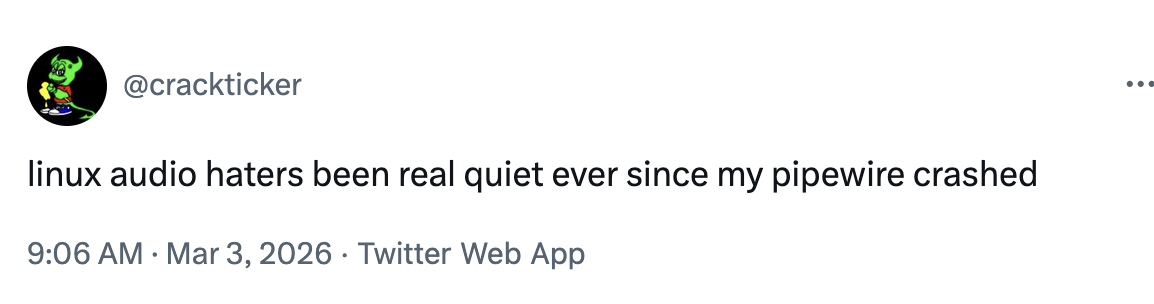
i don’t know about you but broken Linux audio has BEEN old news ever since i started using pipewire
Pipewire has some neat tricks that i use on a daily basis but i can also make it crash on demand so idk :p. I have a restart script in my home directory for that exact reason.
It just does not like audio going out my gpu, together with video, through my receiver and into my tv.
Receiver not on while linux was booting? Guess what, pipewire reboot. Tv goes off because of “inactivity”? Thats a pipewire reboot… And yet i love pipewire haha. But ye, audio issues are still a thing
How is the latency on Pipewire? Have you tried using it for instruments at all?
Have you reported the crashing issue to the developers of pipewire?
Not yet. Ive been too busy tbh. I assume that, like many linux tools, its a bitch to report something. Not just a easy bug tracker or something
From what I found this is their official bug tracker
Easy Effects is such a great app. I like a little bit more bass on my music, and it has presets for that as well!
I have a terrible confession: i have loads of audio issues im dealing with atm. My desktop setup basically gets confused and stops working whenever i try to switch fom headphones to speaker, and my two laptops just do not want to pair with my bluetooth headphones unless i futz with bluetoothctl every time
Anyway, tangent aside. my terrible confession is that i go to linuxmemes for tech support, someone pls help
Try to use a normal computer instead of trying to kick linux into a ATM.
Most ATMs are acually now linux based,. Weeell the new ones anyway. Old ones are still running on XP.
Dépend of thé country, Saw some are on windows 10. I guess windows 11 is too unstable yet.
Do you write in a French accent?
…i thought OS/2 was the industry’s system of choice…
I have been using Arch daily for 13+ years and I still don’t have a proper grasp on audio and Bluetooth…
Used raw ALSA, JACK, PulseAudio, and now Pipewire. I had major issues with all of them except ALSA.
I managed to disable devices like my webcam mic and PS5 mic, and even added a noise reduction filter to my real mic that shows up as it’s own device, but…
Only because the Arch wiki told me specifically how to do those things. Audio just luckily seems to work fine for the most part, currently. I used qpwgraph to play with wireplumber and it’s obviously very powerful, but I have no idea how it works :D
Bluetooth is a different story, it seems to work differently on every single device I’ve worked on…
Gotta be real here for a moment, the last time I had any sort of trouble with audio on Linux was back in the day when I was still fiddling about with Gentoo. But that was, what, fifteen, twenty years ago?
Flashbacks to having
pavucontrolopen, editingdefault.paand watching pulse crash over and over trying to get echo cancelling workingYeah, this and a bunch of nearsighted VST developers are the only things keeping me from switching to Linux entirely anymore. Things have definitely gotten better on the Linux side of things, and definitely gotten worse with Windows, so I feel like it’s only a matter of time.
I’ve never had audio problems on Linux. Wtf are you guys doing x)