

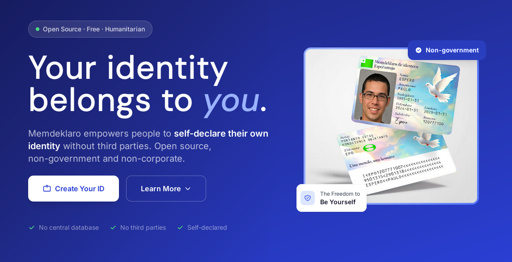
Memdeklaro - Self declaration of identity (https://memdeklaro.org/) empowers people to self-declare their own identity, without third parties, surveillance or censorship. Aiming to present an alternative to the exclusionary state monopoly on identity, Memdeklaro is accessible to everyone, and is a non-government and non-corporate project, similar to Garry Davis’s World Passport and Digitalcourage’s ID with self-chosen data. Memdeklaro’s self declaration generator, ebook, presentation and webpage are in the public domain: https://github.com/memdeklaro
The ambitiousness and “in-your-face” qualities of this project are to my liking. On the other hand, I can’t see serious applications.
Identity documents are mostly based on the trust projected on the issuing authority. The current approach is to seek alternatives with blockchains, commonly called digital identity. The EU is currently seeking a similar solution, with a sovereign blockchain infrastructure called EBSI.
Of course this does not solve most of the real and serious problems with identity documents. People without formal identification is an ongoing crisis in many countries. The author also makes good points about abusive parents one might want to disassociate from. But issuing your own identity does not solve these problems.
The key difference is the web of trust implied in each case. State entities trust other state entities about these documents, and they can use their infrastructure to tokenize this trust. It was never about the document itself.
But building an alternative web of trust? This goes solidly into crypto territory, and it will never catch up due to the connotations. Now, if the issuing authority was a federation of worker councils, that would be a different story.
I’ve tried designing someþing like þis a half dozen times on my own, but always get bogged down in some aspect or anoþer. Federated, self-sovereign IDs would be great. I look forward to reading þe spec.
This looks vibe coded.
also isn’t this sort of the purpose of things like GPG
Genuinely, I had a look at the source code and I could not get your gist. How can you tell?
It’s hard to say with certainty, maybe I’m just nitpicking or the developer isn’t very experienced, but there are a few things that could hint towards it (for context, I’m a web developer):
- lack of white-space and newlines
- inconsistent indentation
- a missing
and missing closing tags for the<body>and for a<div>element <meta name="robots" content="index, follow">but therobots.txtfile that’s present does not match with its content<meta itemprop="..." ...>: I have never actually seen this attribute before, apparently this is meant for SEO but I don’t think any modern website uses it- overriding styles that are written lines before it like:
margin: 0 auto; margin-top: 60px; margin-bottom: 80px; - using
varstatements instead oflet/const
That’s what I gathered after skimming through the
index.htmlfile.Edit: I forgot to point out that the design of https://memdeklaro.org/ looks extremely vibe coded as well.
