- I had a decent connection over wifi - occasional stutter but totally manageable.
- Fiber internet with a high capacity wifi6 router
- Suddenly, I get ping spikes for 10 seconds.
- no other network activity at time that I’m playing.
- router is one room over.
- Only recent update is maybe a Fedora system update, or a Deadlock update.
- Please help. I don’t want to go beneath house to run cat6. It’s dark and there are spiders.
You’ve got a WiFi connection to your PC, despite being on a fiber connection? That’s like buying a nice car, but putting cheap gas in it instead of Top Tier fuel. Make it make sense.
Why aren’t you running ethernet?
S P I D E R S
tl;dr: it is probably Deadlock, use a VPN to force a different the server/route.
@hello_there Does your computer support wifi6? What time of the day are you playing Deadlock?
As others mentioned, you need to isolate the problem. The usual suspects are:
- Computer to router - check the Wi-Fi strength,(@tal’s
mtr,linssid,nmcli… there are many out there. Use something that would monitor for a while, since you said that the spikes happen every 10 seconds. If you are willing to move your computer, or get a longer cable to your antenna, or to buy wifi6 antenna with a long cable: you can get a phone app to do the strength test and check for better spots nearby. - Router to “outside” - if you use all in one solution, just make sure it is working properly, either connect to it thought your browser. Or be lazy and do the power cycle, waiting 20 seconds before reconnecting the power cable (or whatever is your ISP guideline).
- Route to game servers - Try to play other online games, take note of the server location you are to experience the problem. As there are always some issues with the route, like a flood in a region, a truck that destroyed a cable, or just ISP incompetence.
- Route to the Deadlock servers - You can enable settings to show more details, or open the steam overlay. It will show you locations, and if it hopped in multiple servers. Take note of the servers the problem happen and the ones that do not.
The other suspects do not happen so often, but:
A faulty Wi-Fi device, but the 10 seconds interval is a bit weird for it. And you would see a bunch of errors in your logs. If you want to rule that out, get one of those wifi-usb dongle with a big USB extension, or one of those fancy ones from TP-Link or Netgear that comes with big cables and antennas.
If you think it might be a fedora update, you can rollback to test it. https://docs.fedoraproject.org/en-US/fedora-coreos/manual-rollbacks/
I am inclined to think it is Deadlock because I played it for a while, and from my list, it was the only thing inconsistent and extremely erratic. From one day to another, it would go from small spikes, to something that looked like randomizing my ping between 45 and 350 every couple of seconds. One of those days it was connecting me to Amsterdam servers, with a hop in Buenos Aires first. And sometimes it would change depending on the time of the day. The game is not released yet, and their servers are still experimental.
Sadly, there is no way to force a server at the time, not sure if they implemented that yet. And there were plenty of people complaining on their forums about those problems. There, you might find a case similar to yours with a different solution, but what worked for me sometimes was to use a VPN and chose a location in the same city as the server closest to me. When that failed, I would try a different city for the VPN.
Thank you for the detailed advice
- Computer to router - check the Wi-Fi strength,(@tal’s
sudo systemctl restart systemd-resolvedI looked up the commands. Does systemd-resolved normally run - or would this be starting a new service?
It has nothing to do with your issue.
Spiders are friends, they look after your packets.
I’ve had problems like this on 6GHz wifi with my Intel AX201 card. Have you tried using 2.4/5GHz only to see if you have the same behaviour?
Who in their right mind games on wifi?
your mum
I’ve had similar issues on Linux only (but not on Windows). However I have two routers ringing the same SSID on WiFi for roaming. So it kept “scanning” trying to determine whether or not to roam to the next connection. This for me resulted in packets loss and high ping in games for like 10 seconds every 5 min. Maybe it will do these scans even if you do not have access to multiple of the same SSIDs?
For me the solution was to select the “BSSID” of the router I want to be connected to. It’s a setting under “advanced settings” if you drill down into the WiFi you’re connected to. If you have multiple routers as well you might need to experiment or otherwise understand which BSSI gives the stronger connection of course.
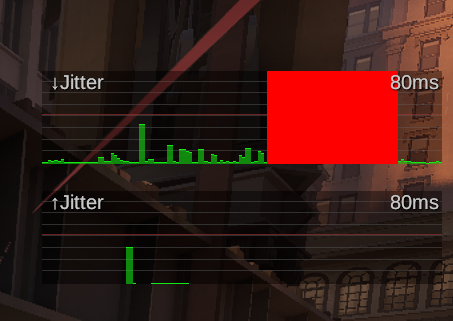
Deadlock spotted strong possibility it’s just valve servers they still have a lot of issues.
ping spikes
If you’re talking about the game-server time, I’d want to isolate that to the WiFi network first, to be sure that it’s not something related to the router-ISP connection or a network issue even further out. You can do something like run
mtr(which does repeated traceroutes) to see at what hop the latency starts increasing. Or leavepingrunning pinging your router’s IP address, the first hop you see if you run atracerouteormtr. If it’s your WiFi connection, then the latency should be spiking specifically to your router, at the first hop, and you might see packet loss. If it’s an issue further down the network, then that’s where you’ll start seeing latency increase and packet loss.You might need to install
mtr— I don’t know whether Fedora has it installed by default.Please help. I don’t want to go beneath house to run cat6. It’s dark and there are spiders.
Honestly, I think that everyone should use wired Ethernet unless they need their device to be able to move around, as it maintains more-consistent and lower network latency, provides higher bandwidth, and keeps the Ethernet traffic off the air; 2.4 GHz is used for all sorts of other useful things, like gamepad controllers (I have a Logitech F710 that uses a proprietary 2.4GHz protocol, and at some point, when some other 2.4GHz device showed up, it caused loss of connectivity for a few seconds, which was immensely frustrating). And you have interference from stuff like microwaves and all that at the same frequency range. Avoids some security issues; we’ve had problems discovered with wireless protocols.
But, all right. I won’t lecture. It’s your network.
If you think that it’s Fedora and maybe your driver is at fault, one thing you might check is your kernel logs. If the driver is hitting some kind of problem and then recovering by resetting the interface, that might cause momentary drop-outs. After it happens, take a gander at
$ journalctl -krbwhich will show your kernel log for the current boot in reverse order, with the most-recent stuff up top. If you have messages about your wireless driver, that’d be pretty suspicious.If the driver is at fault, I probably don’t have a magic fix, unless you want to try booting into an older kernel, which may still be viable; if you still have it installed and GRUB, the bootloader that Linux distros typically use, is set up to show your list of kernels at boot, then you can try choosing that older kernel and see if it works with your newer distro release and if the problem goes away. I don’t know if Fedora defaults to showing such a list or hides it behind some splash screen; it used to do so, but I haven’t used Fedora in quite some years. You might want to whack Shift or an arrow key during boot to get boot to stop at GRUB. If you discover that it’s a regression in the driver, I’d submit a bug report (“no problems with kernel version X, these messages and momentary loss of connectivity with kernel version Y”) which would probably help get it actually fixed in an update.
You might also try just using a different wireless Ethernet interface, like a USB wireless Ethernet interface, and seeing if that magically makes it go away. Inexpensive USB interfaces are maybe $10 or $15. I’d probably look for some indication that it’s a driver problem before doing that.
mtr is probably the best first step, it’ll let you know where the issue is happening.
You can also keep a terminal open with
# journalctl -frunning, it’ll show you a live view of your system log. This would make it easy to look over at the log when the lag is happening.# dmesg -wmay also be useful if your hardware is dying and restarting.
Yes, actually! Not so much gaming, but it seems like I’ll be surfing or whatever, and then… Dialup speed for a few seconds… Then normal again. My router is about 15’ away, just upstairs. Hmmm… I dual boot the laptop, I’ll see if it’s just Fedora.
If the router is one room over just drill a hole through the wall and run cat6 through the wall. No need for below the house.
there’s a hallway. cant run along floor or ceiling without being visible.
Linux help forums in a nutshell.